Tag: Women in Tech

  • Befriending Dragons: From Burnout to Confidence

    Cover of the book titled 'Empowering Women in STEM: Building a Culture of Resilience', edited by Sanya Mathura, featuring three women and one man in hard hats discussing around a tablet.

    Burnout rarely starts with a personal failing. It starts with signals we’ve learned to fight instead of read, inside systems that were never built for everyone. This chapter from Empowering Women in STEM: Building a Culture of Resilience is shared here in full.

    Chapter 23 by Cindy Gross

    I’M BROKEN

    I shrank. My head started pounding, my stomach twisted into knots, and I stared back dispassionately as if nothing had happened. I was at a team event with about 50 people – and once again I was the only woman. The speaker, a coworker, started off with “Gentlemen.” Then a long pause as he pivoted his entire body toward me. “And Cindy.” He made it clear to the whole room that I was the “other” – different, wrong, broken. I felt both invisible and hyper-visible. I could feel every person in the room spend a second contemplating me and how I didn’t fit, then dismiss me as irrelevant. I knew a few of my friends would pity me – we had talked about how this person propped up his own confidence by belittling others – and that wasn’t any better. No one protected me, no one made it clear he couldn’t treat me that way. I felt unsafe, off-balance, and broken. It was the latest in a string of blows that made me feel like I had no path forward. I felt like I was growing smaller and the distance between me and the others in the room grew exponentially. I mentally slumped in exhaustion.

    The thought just wouldn’t leave – I was broken. There was no other way to explain it. I was disappearing in plain sight. Every day I was frustrated, exhausted, making mistakes. With every failure I would add a piece of armor, another way to distance myself from the people telling me I wasn’t doing it right. The distance also created procrastination – why start things that were destinated to fail painfully? I tried to get everything perfect – with no clear idea of what that looked like. I felt incredibly lonely – if I let people in, they would see how broken I was and that would make me feel worse. I wanted to fight the dragons in front of me – the people, the system, the bias.

    My reaction was to overprepare. My emails and documents became impenetrable walls of text that showed I was competent and had thought things through. I avoided confrontation so others would like and support me. You’re all familiar with this, right? It’s the well-documented competence-likability paradox that women face – the double bind that it’s hard to see women as both competent and likable. I knew I was competent, so I felt I needed to become more likeable. My manager even told me that one of my top criteria for a great review the following year was to get a manager on a partner team to like me.

    Another year, a different manager put on my review that I was abrasive. I reached out to a coworker who thought I was joking and told me I was by far the least abrasive and most diplomatic person on the team. Again – the double bind. And it was all exhausting. I was burning out.

    I blamed myself for the truth behind their messages – I wasn’t performing up to the level I knew I could. Again – I felt broken.

    WE’RE NOT BROKEN

    What I would tell my younger self, with the wisdom of my experience, is that I had internalized the leadership friction in the system as personal failings. I wasn’t broken – I was hitting more of the friction than others were because I didn’t fit into the system the same way they did. And it accumulated over time. No system can be built for everyone, and I was feeling the weight of where I didn’t fit the norms and expectations. I was incredibly good at the technical aspects of my job, but I was so exhausted from fighting the system – the friction – that I couldn’t see a way forward. I couldn’t see the system objectively. I couldn’t even see myself anymore. I didn’t know who I was. The friction burned, and it was consuming me.

    Of course, my performance suffered because I was spending so much energy managing other people’s emotions. Living like that, for months on end, meant my body started treating every interaction as a threat. Every project, every meeting, I came up with a playlist of things that might go wrong, of confrontations that might occur, and how I could head them off. I was burning out.

    ANOTHER FRICTION POINT

    One day I walked into a team meeting and announced with excitement that I had two highly qualified women candidates for the open position on the team. My manager’s instant reaction was “we’re not going to lower the bar for them.” Did you hear what I heard? He felt someone had lowered the bar to let me in. I didn’t belong. I wasn’t good enough. No woman could be. And there was no way out.

    I want to give that younger version of me a big hug and a pep talk, to tell her to speak up for herself in the moment, but that version of me didn’t have the energy to do that. No one else spoke up for her – for me.

    Today I can see that my manager thought “the bar” was a clear, highly aligned set of objective criteria. What I see in most hiring and promotion bars is a confusing mess of ambiguous and often hidden criteria that are unevenly applied. I no longer think of it as a bar on a chart and more like a winding, twisty mass with some spots shaped more like a white man than anything else. It’s easier for some people to get through that bar not because they’re more competent but because they look and act like whatever part of the bar the hiring manager is attuned to. No wonder so many women burn out and leave the tech industry after 15–20 years.

    BEFRIENDING DRAGONS

    I gave myself permission to pause, grieve, and build a new map for myself. I took the space to discover and internalize new ways of leading and being. I built relationships with coaches and others who helped me get curious about myself without judgment. I quit my job and went on a discovery journey.

    Instead of thinking of all these dragons I needed to fight – my inner critic, my depression, the burnout, the bullies, the tech industry, individual people, and teams that I’d worked with in the past – I worked to separate the signal from the meaning and the meaning from my actions. Those dragons give us signals we can use. That’s what I call Befriending Dragons™. When we spend our energy getting curious, intentional, and insightful, we can navigate the systems around us with authenticity and clarity – without burning out. The friction becomes a signal instead of fuel on the fire. We redirect our flame, our roar, our energy from an all-consuming inferno to a life-sustaining warmth.

    Our dragons are not monsters to be slain. They give us messages and stand with us when we need them. They are our power. Dragons are our hopes, dreams, and fire – sometimes disguised as fear, criticism, or hopelessness. When we befriend our dragons and deeply listen to their signals, we can lead ourselves and others with self-trust and courage.

    As I figured out the next phase of my work life, I got truly curious about everything in and around me. I let go of the need to know the outcome in advance or to jump straight to action. I learned to stop thinking that I, other people, or systems need to be fixed. Because none of us are broken. Let me say that again. I’m not broken. You’re not broken. The system is not broken.

    MAPS AND TOOLS

    The system works as designed. It works differently for different people, and it funnels resources and energy where it’s designed to do so. When we make space to map out the system and the friction points within it, we can navigate it differently. We can apply our energy where it makes sense for us. We can use that to build our influence and impact, to be rewarded for the work that matters to the organization. Clarity through this mapping is how we step out of overwhelm and into sustainable work. Friction isn’t failure, it’s feedback about the system.

    We need maps of ourselves – our own internal compass – and maps of the systems around us. Then we can see the friction points and have more choices in how to show up and what work to do. I collect those in a Leadership Navigation Playbook™. I’ll share some of the tools that are in my playbook.

    Start with a Navigation Logbook™. Once a day, write down at least one thing you observed – without judgment – about yourself, others, the system, and the friction points. Once a week, read it out loud to an AI tool and ask it to identify patterns including friction points, energy drains, boundary openings, and impact opportunities. Reflect with friends or in a journal about what you’re learning. This is input into your maps.

    There are a variety of ways to learn about ourselves and how others see us. Our Navigation Compass™ indicates how we show up even when the system fails us. What moves you to action? What relationships feel authentic? When do you act from your most authentic self? What helps you see and calibrate to the system? What enables you to see that you’re a person too – imperfect, human, and worthy? Write down anything that makes you feel more or less like yourself.

    Popular compass options include values exercises, leadership or personality profiles, and skills assessments. I’m a fan of the Meaningful Work Kit and the Leadership Circle Profile®. They both go beyond a simple list and help you see and communicate the conditions you need to thrive. Compile this information about yourself in a central location and periodically re-summarize it for the person you have evolved into. This helps you “get on the balcony” and see the big picture.

    I also recommend building a Personal Language Library™. You know those moments when you come up with the perfect thing to say hours after you needed it? Write it down once you figure it out – situations often repeat themselves. We also have those times where we never figure out what to say, such as stating a boundary with the boss. Be proactive and talk a few key scenarios through with a coach, friend, or mentor. Collect that language to use as needed.

    Pay attention to how people and systems work around you. That’s your System Map. What relationships matter? Who has the institutional knowledge that may not be written down anywhere? How are the big decisions truly made? Where are the levers of power and who holds them? What metrics drive the people and decisions around you? What’s hidden – and often wants to remain hidden? When you see “technical debt” – go deeper and name the “leadership debt” that lets it linger. This is how you deepen your understanding of what’s in motion around you and see where you have choices to navigate differently.

    As you navigate with intent, track the positive impact you have. Use metrics that matter to your organization and leaders. Know what metrics your boss and their boss need to hit this quarter – track how you can and did impact that. Gather all the data you can find to quantify your impact and collect anecdotal feedback as you go. Give feedback and data to others – many people will pick up on that and mirror the habit, creating more data about the system and nurturing relationships that matter. This impact goes in your Navigation Impact Log™. This feeds your 1:1 conversations with your manager and your performance reviews. Create a cadence to provide a written summary to people with control over your career – start with the impact you had, then what you did and what evidence you have. Keep it concise and focused.

    As you see yourself and the system more clearly, start experimenting with navigating differently. How do people react? What changes for you? What impact are you having? How do you feel in various situations? This feeds back into your Navigation Logbook and that continues to feed into your maps.

    WE’RE WHOLE, CAPABLE, RESOURCEFUL, AND CREATIVE

    I’ve spent the last few years working to become the person I wish I’d had back when I was struggling in the tech industry. I feel connected, expansive, sovereign. I don’t feel the need to shrink myself or make people like me. I often feel energized. I rarely give in to doing other people’s emotional labor for them. I replaced impenetrable armor with useful boundaries. I moved from surviving to thriving. I walk with confidence, speak my truths, and create ripples of change in the world. My fire now fuels me instead of burning me out. I am not broken. You are not broken. We are whole, capable, resourceful, and creative.

    Because I see the systems around me more clearly, and I know myself much better, I can identify friction points more easily. I can see, with neutrality, when bias like a double bind shows up. I can see when what’s hidden, like a vague success bar, pretends to be a clear metric. If someone calls me abrasive, I can read it as a signal that there’s friction in the system, not a truth about my character. That means I spend less energy fighting and can focus on what’s useful and impactful. I make choices, I navigate with intent, and I iterate as long as it’s useful. I befriend my dragons with curiosity, intent, and ease so they walk beside me and I don’t feel the need to fight them.

    I’ve put together the mindset, tools, and structure that I believe would have let me thrive in my high-paying tech job. It was a rough road for a while, and I’m here on the other side. I’ve built my maps, made choices that feel aligned, and led myself and others in ways that feel sustainable, joyful, and impactful. I wish you the same on your journeys!

    ABOUT CINDY

    Cindy Gross coaches high-capacity women in tech to stop absorbing the friction and start navigating it. After 25 years in enterprise technology, including 18 at Microsoft, she brings technical fluency and human insight to burnout recovery and sustainable leadership. She is an ICF-credentialed coach (PCC), a certified Leadership Circle Profile® practitioner, and the creator of Befriending Dragons™.

    This chapter first appeared as Chapter 23, “Befriending Dragons: From Burnout to Confidence,” in Empowering Women in STEM: Building a Culture of Resilience (CRC Press, 2026). DOI: 10.1201/9781003712589-33.

    Ready to map your own signals?
  • Are you still yourself?

    Are you still yourself?

    Cindy Gross

    Befriending Dragons

    Hi Reader,

    Something I hear a lot right now, underneath the composed exterior:

    “I don’t know if I trust my own instincts anymore.”

    ​

    Not because she’s lost her edge. But because the signals have been contradictory long enough that the self-doubt has started to feel like clarity.

    ​

    If that’s where you are — or somewhere close — I’d like to talk.

    Grab some time with me here: https://befriendingdragons.com/meet

    ​

    I’m also asking a simple question: what’s the thing you’re navigating right now that doesn’t have a clean answer? The one where you’re not sure if the friction is yours to fix, or the system’s.

    ​

    Reply and tell me. I read every one.

    ​

    The leaders I work with are not struggling because they’re not capable. They’re navigating the specific exhaustion of being highly competent inside a system that keeps asking them to be someone slightly different than who they actually are.

    ​

    That is a solvable problem. Not with inspiration. With infrastructure.

    Navigating with you,
    ​Cindy Gross | Leadership Navigation System for High-Capacity Women in Tech​
    🐉 https://befriendingdragons.com

    ​

  • The thing no one tells you about being this good at your job

    The thing no one tells you about being this good at your job

    Cindy Gross

    Befriending Dragons

    Hi Reader,

    The most capable woman in the room is often navigating the most alone.

    Not because she lacks support — but because the systems around her weren’t built to see what she’s actually carrying. The scope that expanded without authority. The feedback that doesn’t add up. The political weather that shifted and nobody named it.

    She’s not confused. She’s operating without a map in terrain that keeps changing.

    That’s what I build.

    I’m offering a Strategic Clarity Call — a working diagnostic where you bring one real situation and leave with a clear read and your first concrete moves. It’s not a consultation. It’s infrastructure.

    If something is shifting for you right now — your role, your positioning, your next move — this is where we start:

    → Book your Strategic Clarity Call​

    P.S. Know someone who’s navigating a reorg, a comp conversation, or a role that’s shifted under them? Forward this. The right conversation at the right moment changes everything.

    Navigating with you,
    ​Cindy Gross | Leadership Navigation System ​
    🐉 https://befriendingdragons.com

    ​

  • The Real Workplace Saboteur Isn’t Identity. It’s Friction.

    The Real Workplace Saboteur Isn’t Identity. It’s Friction.

    Cindy Gross

    Befriending Dragons

    Hi Reader,

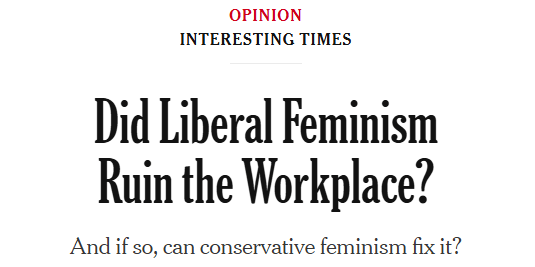
    A recent, provocative headline in The New York Times asked if feminism ruined the workplace.

    This question is fundamentally flawed. It’s a distraction that points the finger at a group of people instead of at the systems that weren’t built for everyone. It invites us to debate which type of person is problematic, rather than asking the far more useful question: Why do our workplaces still generate so much friction for so many people?

    The problem isn’t, and has never been, a specific identity. There is nothing inherently wrong with any gender, race, or background.

    The problem is the rigid, narrow, and often unspoken expectations our workplace systems have bolted onto the concept of an ideal employee—expectations that have been unreasonably tied to gender, race, disability status, communication style, and cultural background. For decades, the default operating system for success was based on a very specific archetype—an in-group. This created a set of invisible rules about what a leader looks like, how a leader sounds, and how a leader acts.

    This is what I call Leadership Friction.

    It’s the invisible, systemic force that creates drag on individuals and organizations. It’s the tax paid by anyone and everyone who doesn’t perfectly align with that default in-group model.

    And this friction isn’t just paid by those whose authentic style doesn’t match the default. It’s also paid by those in the in-group who, operating from a different starting point, often can’t see or understand the friction points that are painfully obvious to others. This creates massive organizational blind spots, miscommunication, and inefficiency, where countless hours are wasted managing misalignment that stems from these different, unexamined experiences.

    Leadership Friction is the invisible battle a leader from an out-group fights when their confidence is called aggression while the in-group standard is called authoritative. It’s the unrewarded glue work disproportionately shouldered by those expected to be collaborative, work that is critical for team cohesion but mysteriously absent from performance reviews. It’s the constant, exhausting background process of having your competence questioned in ways others are not.

    This friction is the real saboteur. The true ruin isn’t that diverse professionals are in the workplace. The ruin is the staggering amount of energy, talent, and innovation we waste navigating this friction.

    Think of the sheer volume of brilliance that is lost—not to a lack of skill, but to Environmental Exhaustion. This is the exhaustion that comes from pushing against a system that was simply not built for you. It’s the exhaustion that leads your most indispensable, high-impact Keystone Leaders to a stay or go crossroads, not because they can’t do the job, but because they are tired of paying the friction tax required to do it.

    Bringing a diversity of people into the workplace didn’t ruin it. It simply held up a mirror and exposed the systemic friction that was already there, slowing everyone down. The discomfort some feel isn’t from the ruin; it’s from the revelation.

    Stop asking if any group ruined the workplace. Start asking how we can finally address the systemic friction that drains our best people. The goal isn’t to fix people to fit the system. The goal is to diagnose the system and equip all leaders with the tools to navigate it, turning that friction into strategic leverage for themselves and their organizations.

    That is how you build a workplace that doesn’t just survive, but thrives.

    This is a conversation I’m passionate about, and I’ve just posted this article over on LinkedIn to get a wider discussion going.

    My question for you is: How much of your team’s energy is spent navigating friction versus doing the work?

    I would be honored if you would bring your voice to the public discussion. https://www.linkedin.com/pulse/real-workplace-saboteur-isnt-identity-its-friction-cindy-gross-pcc-2yklf​

    I’ll also be exploring these themes in person this week (Nov 19-21) at the PASS Data Summit in Seattle. If you’ll be there, please find me at my talk, “I got the role… Now what?”, or at the Community Experts Clinic.

    With dragonfire warmth and enduring wisdom,
    ​Cindy Gross | Founder, Befriending Dragons | Your Leadership Navigation Coach
    🐉 https://befriendingdragons.com

    ​📅 Book a call to explore coaching together

    ​

    🎁 Grab your Dragon Playbook Starter Kit​

    Start with:

    1. Culture Compass – Define what you need to thrive in a work culture.
    2. Boundaries for Thriving – Name, refine, and express values-based boundaries that protect your energy (perfect to use with the AI tool!).

    ​

  • Are you tired of acting like you’re okay?

    Are you tired of acting like you’re okay?

    Cindy Gross

    Befriending Dragons

    Hi Reader,

    “I’m tired of acting like I’m okay when I’m not.”

    This was shared by a leader in my Befriending Dragons community, and it perfectly captures what I’m hearing in dozens of private conversations right now.

    My new article on the “Layoff Echo” is striking a nerve. We’re all seeing it: the burnout of indispensable “Keystone Leaders,” the isolation, and the immense, unspoken pressure to just… keep performing.

    If this resonates, I want to invite you to a space where you don’t have to pretend.

    On Tuesday, November 11th, I’m hosting the Befriending Dragons Roundtable.

    This is not a webinar. It’s not training. It’s not a performance of strength or strategy.

    It is my free, monthly, confidential space for women and non-binary leaders to connect with peers who get it. It’s a space to process what’s real—the grief of layoffs, the weight of being “the strong one”—and learn to lead without abandoning yourself.

    You don’t have to arrive with clarity or confidence. You just have to come as you are.

    The Roundtable is free for all members of the Ember Circle (my private, no-cost community).

    If this is the space you’ve been looking for, I invite you to join us.

    Click Here to Join and Get the Zoom Link for Tuesday https://community.befriendingdragons.com

    I hope to see you there.

    P.S. If you missed the “Layoff Echo” article that sparked this conversation, you can read the full analysis here. https://www.linkedin.com/pulse/layoff-echo-hidden-crisis-your-workforce-cindy-gross-pcc-jrkxc

    With dragonfire warmth and enduring wisdom,

    Cindy Gross | Founder, Befriending Dragons
    Your Leadership Navigation Coach

    🐉 ​https://befriendingdragons.com

  • Cindy Gross on Navigating Tech Careers: Listen Now!

    Cindy Gross on Navigating Tech Careers: Listen Now!

    Lisa Gillette's podcast cover

    Cindy Gross Featured on Lisa’s Podcast: Grace, Grit, Getting it Done!

    Cindy Gross joined Lisa Gillette’s podcast, Grace, Grit, Getting it Done! to discuss empowering women in tech and navigating workplace culture with confidence. In the episode Befriending Dragons: Empowering Women in Tech to Navigate Work Culture with Confidence, Cindy shared insights from her own career in tech and her work as a Women in Tech Leadership Coach.

    She explored key strategies for setting boundaries, claiming opportunities, and owning one’s value in a male-dominated industry. This conversation is a must-listen for anyone looking to thrive professionally while fostering self-assurance and advocacy.

    Catch the episode and gain practical insights into building a fulfilling and impactful career in tech with Cindy’s expert guidance!

    Listen Now

  • Reclaiming My Voice, Becoming Me – A Befriending Dragons Story

    In the mornings I search my closet to find the perfect outfit that shows I’m technical enough, I’m smart enough, I fit in. One day I wear a skirt, and my manager can’t seem to process it, I have gone outside his expectations. He flips to the script of “this is a woman, not a skilled computer expert who knows more about her area of expertise than almost anyone else in the world.” He can’t hold “woman” and “good at technical stuff” in his brain at the same time. His obviously confused comments about how nice I look deflate me all day, and that’s the last time I wear a skirt to work. Another day my manager comments that it’s great that I’ve brought some women candidates to interview for the open position on our team, but that we won’t lower the bar for them. As if the bar isn’t already shaped like a white man, with false proxies that exclude so many qualified people. When he finds out a coworker made disgusting, sexually explicit comments to me I overhear him say to a coworker that the bully can’t be blamed since he thought I had picked up the coworker I was walking with in a nearby bar. I move to a team that rarely interacts with customers, a team where I have no chance of encountering my old teammates. They have much more of an casual clothing vibe. When I wear my existing wardrobe, clothes from boutique stores, I get puzzled comments asking where am I going after work, is it someplace fancy? One of the few other women on the team comes over to tell me she’s glad I continue to dress up because it makes her feel less out of place when she wears similar clothes. What I think is “Why can’t I ever get it, ME, right?” Why can’t I fit in? Why are my dragon scales always too shiny or not shiny enough? Why is my roar always silenced? When did I lose my voice, when did I start spending so much emotional energy to walk a fine line between likable and competent? When did I give in to the bullies?

    It was years before I realized my path to belonging & success became very narrow when I reported the worst bully, a sexual harasser, to my manager. The manager talked me out of reporting to HR. He encouraged me to silence myself, to keep quiet, all to keep my chance at a promotion. What I heard is that my voice doesn’t matter, or even worse my voice is destructive to my career. I didn’t realize then that my chance at a promotion was gone the moment I spoke up about the harasser, the bully, even in the privacy of one sympathetic person’s office. It was clear the so-called “brilliant jerk” who harassed me was just too valuable to the team, and I was not valuable enough. Instead of insisting I was as valuable, actually even more valuable because I wasn’t a bully, I took my dragon roar and internalized it as a silent scream. I looked around at the sea of men I worked with and saw what others thought tech looked like – not me. I tried to muffle my inner shrieks and focus on creating success by changing myself, ignoring my own brilliance and aptitude for the job. I just knew if I could make myself even more “one of the guys,” if I could suppress the “bad” aspects of my femininity, I could “win.” I could manage my way out of this by tightly controlling everything – myself, my voice, my manager, my coworkers, how much of myself I shared with my boyfriend. Only I couldn’t. I didn’t. The more I silenced myself, the more I changed my dragon roar into a silent scream, the more I lost myself.

    I imagined myself as a solitary dragon, alone in my safe cave. As long as I kept people at a distance I could survive. I never even considered that I deserved to thrive instead. I nursed my internal wounds, mostly by minimizing and ignoring them. I imagined my loneliness as peaceful solitude. I hoarded my energy, my thoughts, my feelings. I told myself I was in control, I was exercising my power. I shape-shifted into a shadow of myself, a caricature. I closed all the gates around me to keep the bad things away, ignoring that I also kept the good things away. Like so many trauma victims, I internalized the bully’s actions as partially my own fault. I thought I could, must, change myself to avoid future bullies.

    But that’s not the way the world works. Instead of looking at myself as a scary dragon, I can choose to see myself as a free agent in the world, a friendly dragon who can fly where I want, when I want, how I want. I know there’s the reality of the white patriarchy, a system that builds success bars shaped like a narrow subset of cishet white men. Because of my own privileges as a white-presenting woman with one parent who graduated from college, because of the perseverance and grit and pure luck that let me slide through the edges of the white patriarchy and accumulate some wealth, I have the freedom to put myself in another part of the world, a part where I can thrive. My dragon scales are just fine the way they are, and I choose how much, what kind of, light to shine on them, on myself. I can befriend this bully culture dragon, I can stop internalizing it and stop trying to fix myself. I can make my experience a friendly dragon. That jerk who bullied me, who was found guilty of sexually harassing me when I finally reported him to HR, doesn’t define me. I don’t have to change myself, I don’t have to become invisible and silent to people like him and the people who excuse his behavior. He behaved very badly, he committed verbal violence. The system at work tried to find the balance of action so that neither of us would sue or speak out too much. But they misjudged. I did speak out. I reclaimed my voice. I started to speak out about my experience, at first quietly in small groups. Then from a stage. Then directly to my new team. Then loudly for the world to hear. I left Microsoft without signing their confidentiality agreement, without letting them steal my voice once again in return for a few month’s pay.

    I reclaimed my roar and ended my internal screaming. I befriended that dragon. I reclaimed my voice and my feminine side. I belong because I decide what that means for me. I choose to step away from patriarchy, the quest for perfection, whiteness, hierarchy, and conformity. I choose thrival, self-care, and relationship-based work.

    I see myself as a beautiful, free, contradictory, powerful, wise, and confident dragon with a loud roar. I am ready to take on the world, to speak truth to power. I create my own path. I journey with women, we reclaim our voices, we move on to new, bigger lives after a bully tries to make us small. We nurture new paths, new cultures, new open gates where we can be ourselves, create success, and generate a sense of belonging in our cultures. We ROAR!

  • Moving Beyond Unconscious Bias – Good People Matter!

    Presented at SQL Saturday Oregon on October 24, 2015

    by Julie Koesmarno and Cindy Gross

    Good People

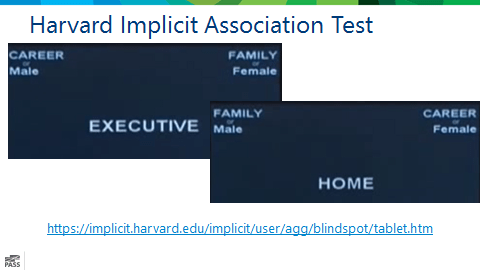
    We’re good people. As good people we don’t want to think we do things that have negative consequences for others. But sometimes our subconscious can fool us. What we intend isn’t always what happens. We think we’re making a totally rational decision based on our conscious values – but subtle, unconscious bias creeps in. Yes, even for good people. For 20+ years folks at Harvard have been using something called the Implicit Association Test (IAT) to help us identify our biases.

    Take this IAT on gender and career – the results may surprise you: https://implicit.harvard.edu/implicit/user/agg/blindspot/tablet.htm

    Watch Alan Alda take the test, it will give you a feel for how it works: https://www.youtube.com/watch?v=2RSVz6VEybk

    image

    Patterns and Categories

    The human brain works with patterns and categories. It’s how we make it through the day. We are bombarded with 100s of thousands of data points every day – we can’t possibly think through each one every time. We unconsciously assign data points, including our perception of people, into buckets. Those buckets have values and characteristics assigned to them that may or may not reflect the individual person we put in that bucket.

    This automatic assignment is called intuitive thinking or system 1 thinking. It’s easy and takes little effort. It serves us well and lets us take on many tasks every day. However, it also sometimes leads us down the path of thinking we’ve chosen the “best” person when we’re really hired someone who meets some set of assumptions.

    Sometimes we use slow thinking, or system 2 thinking. It’s rarely a conscious decision, something just makes us take some extra time and we usually don’t even realize it. That’s when we stop to question what we’re doing – maybe we adjust which categories we put someone in or we adjust the category or the values and judgments associated with it. We’re good people but system 2 thinking is tiring and we just can’t do it all the time.

    image

    Diversity Matters

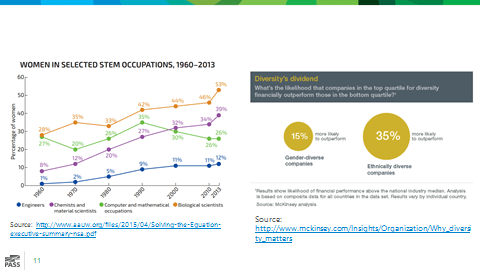
    Why does diversity matter at work? Personally, when we’re on a diverse team we tend to have higher personal and job satisfaction. Diverse teams are interesting and we often learn more. People who don’t feel like they’re the “only one” of something (gender, sexual orientation, race, introvert/extravert, etc.) relax, contribute more, and are more productive. And study after study shows that more diverse teams lead to better products and a better bottom line.

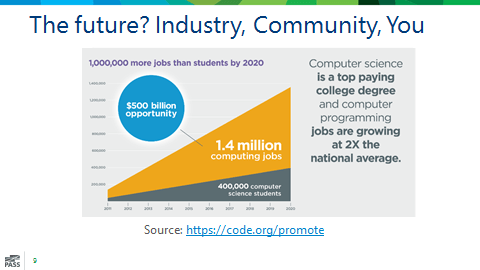
    Companies with women on their boards have higher ROIs, more diverse companies tend to perform above average, and let’s face it – we don’t have enough STEM graduates to fill needed jobs if we don’t encourage a more diverse group of people to enter the field.

    imageimage

    Mind Tricks

    But we’re good people and we don’t make these snap judgments. We are rational and we always know why we made a decision. Or do we?

    image

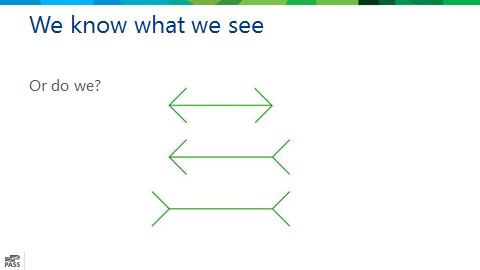
    Optical illusions fool us all the time. Even knowing those lines are all the same length, did you have to measure them just to be sure? The same thing happens in our interactions with people. What’s the first thing that comes to mind for single parent, introvert, doctor, CEO, or programmer? That first thing hints at your categories – the categories built up by a lifetime of media saturation filled with type-cast actors.

    image

    Back to the science of bias. Let’s think about resumes. In one study, resumes were handed out to academics who were asked to rate the job candidates for competency, hireability, mentoring, and suggested salary. Some resumes were for John and some for Jennifer. Professors of all genders rated Jennifer 25% less competent and less likely to be hired. They rated John worth about $4000 more. When asked why they gave ratings their justifications sounded rational but…. 4 industry publications was awesome for John and 4 was just not enough for Jennifer. They are good people but they (we!) are at the mercy of their subconscious and years of societal conditioning.

    Moving On

    We’re good people so what do we do?

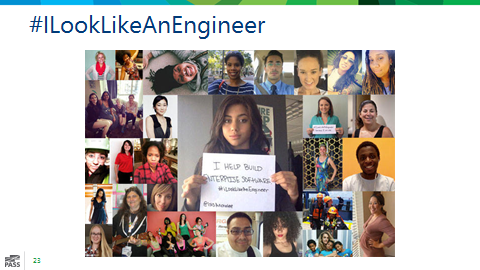
    Take the IATs – there are many, take at least a couple and understand your unexpected biases. Talk about this with others so we all become comfortable talking about our subtle biases. Work to consciously update your mental categories – seek out images and reminders of people who are different and successful. Now that you know your own categories a bit better, be more mindful about switching to system 2 thinking. Reach out to one person and mentor them. Spend time with someone who makes you uncomfortable. Pay attention to the “firsts” (the first autistic character on Sesame Street, the first black President, the first whatever) and see if that helps you update your mental categories.

    Increase the pipeline. Participate in groups that help kids learn to code. Recruit beyond your normal network, post jobs on diversity sites, and consider non-traditional backgrounds. Join diverse groups that don’t match your own diversity.

    Be careful with words. Is someone bossy or exhibiting leadership? Is someone aggressive or a go-getter? Are they emotional or passionate. You may be surprised how you assign different words for the same behavior in unexpected ways.

    When you post a job, only list something as “required” if it truly is. Women for example tend to only apply if they meet almost all the requirements, men tend to apply if they meet a few. Do you really require Java experience or do you need a good coder who is willing to learn new things? Don’t ask for a specific type of leader, look for someone who can lead in any of many productive ways. Explicitly state that you value a diverse team. And beware of subtle stereotypes – words like best, rock star, action-oriented define a particular picture but may not represent what you’re really looking for.

    When reviewing resumes, have HR take off names, cities, and years. Before you pick up a resume decide on your priorities – does experience or willingness to learn matter more for example? Look for people who fill gaps rather than trying to replicate people you already have. And remember, system 2 thinking is tiring so do this when you’re alert and can take the time to think about what you’re doing.

    For the interviews, have a diverse group participate. Simply looking at picture of or talking about diverse people before starting interviews increases the chance you hire with diversity in mind. Don’t confuse either confidence or “geek cred” with competence. Keep an open mind about different ways of approaching problems – it’s the result that matters.

    Many flowers make a beautiful bouquet – @IsisAnchalee

    Let’s Do It!

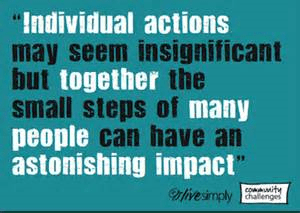
    What is your personal pledge today?

    image

    Full slide deck is available at http://smallbitesofbigdata.com/archive/2015/10/26/moving-beyond-unconscious-bias-good-people-matter.aspx

  • Women in Technology – Why Does it Matter?


    Women in Technology – Why Does it Matter?


    The yearly SQL PASS summit is always one of my favorite times of year. It’s a week packed full of great technical content and many networking opportunities. Not to mention the parties and fun. J And of course the #sqlkilts. One of the highlights of the #sqlpass conference is the Women in Technology (WIT) Luncheon. This year quite a few men (and a couple of women) wore kilts that day and several of those wore shirts designed by @MidnightDBA saying “I’m supporting Women in Tech. What are YOU doing? (Plus, I look hot in a skirt)”. They came with the rest of us to hear a panel that discussed topics such as how women influence innovation, how women affect the bottom line, and why high tech jobs benefit women. Many audience members participated with comments and questions. I was so inspired by the day that I am taking some of the key points and summarizing them.


    This year we had a great panel of speakers:

    Billie Jo Murray, General Manager, SQL Central Services, Microsoft

    Nora Denzel, Senior Vice President and General Manager – Employee Management Solutions, Intuit

    Michelle Ufford, Senior SQL Server DBA, GoDaddy.com

    Denise McInerney, Staff Database Administrator, Intuit

    Stacia Misner, Principal, Data Inspirations


    The number of men in the audience at the WIT luncheon continues to grow each year, as more people realize that supporting women in tech takes support from both men and women and that everyone benefits from the diversity. As Nora said: “Welcome to the women, and also welcome to the men, and also welcome to the men in skirts”. The number of women in technical jobs is decreasing at a faster rate than in other occupations, and the percentage of computer science graduates who are women is plummeting. Going forward it will be harder and harder for companies to recruit women into technical jobs. There doesn’t seem to be a good explanation for why this is happening. There are plenty of hypotheses but so far there doesn’t seem be consensus on the causes and more importantly on what to do about it.


    So why do we care? Why does it matter how many women there are in tech? Why do we need a special group, time, or event just for WIT? There were many good points given about this during the lunch, both from the panel and from the audience. As Nora and Michelle both pointed out, at a high level diversity helps teams deliver a better product and fosters innovation. When you have people from different backgrounds, they approach the problem/product/issue in varying ways. The more approaches you have during the development phase and the broader the base for feedback, the more innovative and useful the end product is. This isn’t just some people sitting around a room and complaining; studies have borne this out. Gender is only one aspect of diversity, but it’s an important one. As the panel said, diversity is a means to an end. Diversity done right attracts great talent, leads to higher ROI, and makes the workplace healthier. Diverse companies are more likely to be voted a great place to work and that higher morale can translate to a better bottom line. Denise shared a great quote from Bill Gates. BillG was giving a speech in Saudi Arabia to an audience segregated by gender. There was a question to BillG about whether Saudi Arabia could become a top competitive economy by 2010. His answer: “…if you’re not fully utilizing half the talent in the country, you’re not going to get too close to the top.”


    Women (yes, stereotypically and not across the board) tend to approach tech projects differently than men. Often they take the perspective that technology’s purpose is to help others and therefore they think of projects in those terms. Teams shaped by stereotypically male dominated thinking often take an approach of fixing a problem or using something just because it’s “cool”. Both approaches have their place, and when they’re combined the innovation can explode (hopefully in a good way).


    So what incentives are there for women to take a tech job and stay in the tech industry? I would argue that it’s a fun career, but what else is enticing? How about money and financial security? Tech jobs tend to pay well in general. The gender wage gap tends to be lower in the tech industry, so for the same job there’s a higher chance a woman will be paid as much as a man with the same skills. As Denise said, with the increased financial security from a tech job, a woman has greater control over all aspects of her life. From another perspective, as women in tech we are “thought workers”. That means we are valued for how smart we are, for our brains. In the tech world we can compete on the basis of our ideas. Despite the constant media message about women having to always compete for who looks the best, see who can dumb themselves down the most, and avoid math and science, in the tech world we can shine based on our merits.


    If it’s such a great career path for women, why aren’t there more women here? I already mentioned the rapidly decreasing percentage of women with computer science degrees, though I have heard that in other countries that may not be the case. But why don’t women apply for tech jobs? Is it the geek image? A lack of desire to work around all that testosterone all the time? The media-fed feeling that women just aren’t good at math, science, and the “hard stuff”? The lack of glamour or perception of long hours? A feeling that we won’t fit in? Again, there is no consensus on why. If we could figure that out, maybe it would be easier to solve the problem. As Jimmy May said, “she-geeks are cool”, and we need to communicate that to women.


    For women already in the tech arena, how do we approach our jobs? There seemed to be wide agreement that as women we are much more likely to seek perfection of an idea before we present it. We aren’t as likely to speak up at meetings if we don’t feel we are 100% prepared. We need to be more comfortable with being uncomfortable. It’s ok to make mistakes or to say “I’ll have to get back to you”. As Billie Jo said, women need to “sit at the table”. This applies both literally and figuratively. She talked about attending large meetings with so many attendees that there were chairs lining the walls as well as around the table. And who does she see sitting in the chairs “out of the way” around the edges instead of at the table? Women. Take a seat at the table, say something even if it’s not brilliant, and be an active participant. Despite the common perception of many women, we don’t have to know everything and do everything to be good at our jobs. Don’t wait for perfection before acting; step in and become a participant. The example was given that if a job application has ten requirements a women with “only” nine qualifications will not apply, but a man with only one qualification is likely to submit an application. That’s a bit exaggerated but does show a gender gap that many of us can identify with. Get over it! Move on and become a player in the tech game!


    Now we’re all convinced that we need to have WIT. And we also know women aren’t getting many computer science degrees. So who do we recruit? How about math or physics majors? Billie Jo expressed an appreciation for music majors because the way their minds work is similar to what is needed in a tech environment. I know very successful techies with degrees in such seemingly unrelated fields as English. So don’t limit your search to the typical candidates. If something isn’t a true, absolute requirement, word the job description so it’s clearly a “nice to have” and you may see more women apply. Try to find the essence of what you’re looking for and include that description instead of some example of how someone else typified that essence. And remember that a broad background in college and life is very helpful. Billie Jo pointed out that her experience is that women tend to have a broader background in their coursework. This makes them more flexible and often makes it easier for them to fit in and advance at work. Stacia made the point that we need to look at people in the business world, especially for business intelligence type work. Don’t think of tech vs. non-tech. If IT people rely on a business person who consistently takes the real world requirements and makes them understandable to a techie, maybe they are a candidate for an IT job. Look beyond the normal and expected and you may be surprised who you find.


    Life/Work balance always seems to come up when we talk about WIT. It’s not only women who need this balance, but for some reason we seem to be the ones who visibly seek it. This is a discussion for another time, but one important point an audience member made is to ask your family for help. It’s ok to tell your spouse that you’re going to SQL PASS next year and it’s the partner/spouse’s responsibility to look after the kids that week. It’s ok to ask them to do some extra housework while you prepare the presentation you’re going to give at your local user group (or at SQL PASS!). You support them and they feel good when they get to return that support. So ask for support from your friends and family and don’t feel bad about it!


    So what can each of us do to support and encourage WIT? Some of the ideas suggested include:

    ·         Watch the lunch panel here: PASS Summit 2010 Women in Technology Live Streaming Panel Discussion http://www.sqlpass.org/summit/na2010/LiveKeynotes/WITLuncheon.aspx

    ·         Don’t wait to be perfect or have perfect knowledge before you act.

    ·         Mentor women who would make good SQL MVPs or SQL MCMs (BJ offered to help!).

    ·         Don’t put up with a lack of WIT support at your company.

    ·         Be a peer mentor (to a man or woman) and seek out a peer mentor (man or woman).

    ·         Nominate qualified WIT peers for the MVP program.

    ·         As a WIT: submit an abstract for a conference, offer to speak at a user group or code camp, get involved in public/visible ways.

    ·         Have 1:1 conversations about tech, WIT, and/or diversity with people you can influence.

    ·         Thank the WIT in your life, starting with the SQL PASS WIT planning team!


    References:

    #passwit search https://twitter.com/#!/search/%23passwit

    #passwit search http://archivist.visitmix.com/adc612a0/1

    Main WIT page at SQLPASS http://wit.sqlpass.org/

    https://twitter.com/#!/sqlpass

    https://twitter.com/#!/pass_wit


    Blogs

    http://www.midnightdba.com/Jen/2010/11/sqlpass-day-2-wit-luncheon-live-blog/

    http://www.sqlservercentral.com/blogs/kathi_kellenberger/archive/2010/11/17/pass-summit-report-3-women-in-technology-rock.aspx

    http://nullgarity.wordpress.com/2010/11/14/the-kinetic-serendipity-of-the-written-word/

    http://wit.sqlpass.org/WITBlogs/tabid/3018/Default.aspx