Category: Race + Gender Equity

  • Moving Beyond Unconscious Bias – Good People Matter!

    Presented at SQL Saturday Oregon on October 24, 2015

    by Julie Koesmarno and Cindy Gross

    Good People

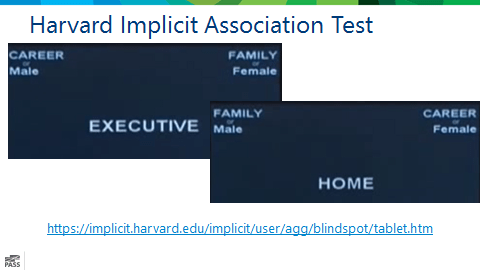
    We’re good people. As good people we don’t want to think we do things that have negative consequences for others. But sometimes our subconscious can fool us. What we intend isn’t always what happens. We think we’re making a totally rational decision based on our conscious values – but subtle, unconscious bias creeps in. Yes, even for good people. For 20+ years folks at Harvard have been using something called the Implicit Association Test (IAT) to help us identify our biases.

    Take this IAT on gender and career – the results may surprise you: https://implicit.harvard.edu/implicit/user/agg/blindspot/tablet.htm

    Watch Alan Alda take the test, it will give you a feel for how it works: https://www.youtube.com/watch?v=2RSVz6VEybk
    image

    Patterns and Categories

    The human brain works with patterns and categories. It’s how we make it through the day. We are bombarded with 100s of thousands of data points every day – we can’t possibly think through each one every time. We unconsciously assign data points, including our perception of people, into buckets. Those buckets have values and characteristics assigned to them that may or may not reflect the individual person we put in that bucket.

    This automatic assignment is called intuitive thinking or system 1 thinking. It’s easy and takes little effort. It serves us well and lets us take on many tasks every day. However, it also sometimes leads us down the path of thinking we’ve chosen the “best” person when we’re really hired someone who meets some set of assumptions.

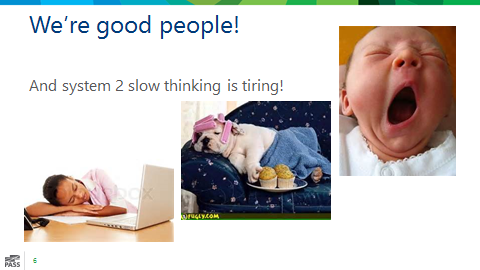
    Sometimes we use slow thinking, or system 2 thinking. It’s rarely a conscious decision, something just makes us take some extra time and we usually don’t even realize it. That’s when we stop to question what we’re doing – maybe we adjust which categories we put someone in or we adjust the category or the values and judgments associated with it. We’re good people but system 2 thinking is tiring and we just can’t do it all the time.
    image

    Diversity Matters

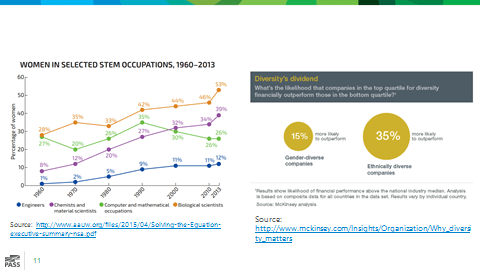
    Why does diversity matter at work? Personally, when we’re on a diverse team we tend to have higher personal and job satisfaction. Diverse teams are interesting and we often learn more. People who don’t feel like they’re the “only one” of something (gender, sexual orientation, race, introvert/extravert, etc.) relax, contribute more, and are more productive. And study after study shows that more diverse teams lead to better products and a better bottom line.

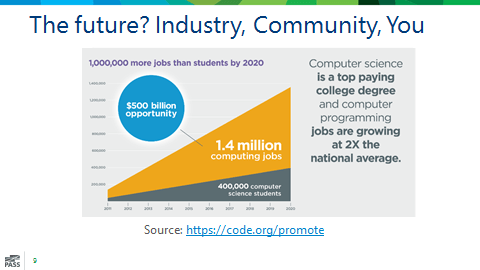
    Companies with women on their boards have higher ROIs, more diverse companies tend to perform above average, and let’s face it – we don’t have enough STEM graduates to fill needed jobs if we don’t encourage a more diverse group of people to enter the field.
    imageimage

    Mind Tricks

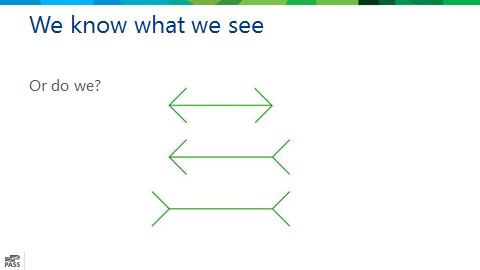
    But we’re good people and we don’t make these snap judgments. We are rational and we always know why we made a decision. Or do we?
    image

    Optical illusions fool us all the time. Even knowing those lines are all the same length, did you have to measure them just to be sure? The same thing happens in our interactions with people. What’s the first thing that comes to mind for single parent, introvert, doctor, CEO, or programmer? That first thing hints at your categories – the categories built up by a lifetime of media saturation filled with type-cast actors.
    image

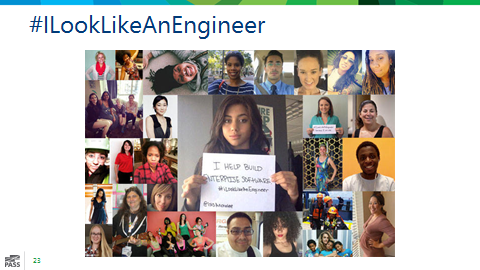
    Back to the science of bias. Let’s think about resumes. In one study, resumes were handed out to academics who were asked to rate the job candidates for competency, hireability, mentoring, and suggested salary. Some resumes were for John and some for Jennifer. Professors of all genders rated Jennifer 25% less competent and less likely to be hired. They rated John worth about $4000 more. When asked why they gave ratings their justifications sounded rational but…. 4 industry publications was awesome for John and 4 was just not enough for Jennifer. They are good people but they (we!) are at the mercy of their subconscious and years of societal conditioning.

    Moving On

    We’re good people so what do we do?

    Take the IATs – there are many, take at least a couple and understand your unexpected biases. Talk about this with others so we all become comfortable talking about our subtle biases. Work to consciously update your mental categories – seek out images and reminders of people who are different and successful. Now that you know your own categories a bit better, be more mindful about switching to system 2 thinking. Reach out to one person and mentor them. Spend time with someone who makes you uncomfortable. Pay attention to the “firsts” (the first autistic character on Sesame Street, the first black President, the first whatever) and see if that helps you update your mental categories.

    Increase the pipeline. Participate in groups that help kids learn to code. Recruit beyond your normal network, post jobs on diversity sites, and consider non-traditional backgrounds. Join diverse groups that don’t match your own diversity.

    Be careful with words. Is someone bossy or exhibiting leadership? Is someone aggressive or a go-getter? Are they emotional or passionate. You may be surprised how you assign different words for the same behavior in unexpected ways.

    When you post a job, only list something as “required” if it truly is. Women for example tend to only apply if they meet almost all the requirements, men tend to apply if they meet a few. Do you really require Java experience or do you need a good coder who is willing to learn new things? Don’t ask for a specific type of leader, look for someone who can lead in any of many productive ways. Explicitly state that you value a diverse team. And beware of subtle stereotypes – words like best, rock star, action-oriented define a particular picture but may not represent what you’re really looking for.

    When reviewing resumes, have HR take off names, cities, and years. Before you pick up a resume decide on your priorities – does experience or willingness to learn matter more for example? Look for people who fill gaps rather than trying to replicate people you already have. And remember, system 2 thinking is tiring so do this when you’re alert and can take the time to think about what you’re doing.

    For the interviews, have a diverse group participate. Simply looking at picture of or talking about diverse people before starting interviews increases the chance you hire with diversity in mind. Don’t confuse either confidence or “geek cred” with competence. Keep an open mind about different ways of approaching problems – it’s the result that matters.

    Many flowers make a beautiful bouquet – @IsisAnchalee

    Let’s Do It!

    What is your personal pledge today?
    image

    Full slide deck is available at http://smallbitesofbigdata.com/archive/2015/10/26/moving-beyond-unconscious-bias-good-people-matter.aspx

  • The Big Data Dragon flies on to Microsoft AzureCAT

    “Always in motion is the future” – YodaCindyMar2015

    On June 1 I will be moving into a new role on AzureCAT. I tried the small business consulting world with Neal Analytics and it just wasn’t a good fit for me and my passions. So here I go, on to new challenges at Microsoft! I’ll be making the world a better place with the help of Big Data.

    And while I’m making changes, I’ll also be moving from Boise, ID to the Redmond, WA area. It’s new adventures all around for me. I’ll miss Boise – my friends, my political battles, the greenbelt and hiking trails, sitting on the patios downtown. And I’m also excited about all the new opportunities I’ll have in my new, blue state.

    Bring it on world, I’m ready!

    cindygross@outlook.com | @SQLCindy | http://www.linkedin.com/in/cindygross | http://smallbitesofbigdata.com

    Cross-published on:

    http://befriendingdragons.com/2015/05/07/the-big-data-dragon-flies-on-to-microsoft-azurecat
    http://smallbitesofbigdata.com/archive/2015/05/08/the-big-data-dragon-flies-on-to-microsoft-azurecat.aspx

  • Where are the Women in Technology? #BoiseWIT

    Where are the Women in Technology? #BoiseWIT

    Where are the Women in Technology?

    The Event

    This year’s Boise Code Camp has an exciting new panel session: “Where are the Women in Technology?” We have a great lineup of women who will help us all understand why women in tech matter to your bottom line. The panel invites everyone of any gender to attend and learn more about how we can all help make our businesses more productive, our work culture more pleasant, and our employees and coworkers happier. The session is sponsored by “Girl Develop It! Boise”.RosieInTechWIT

    Saturday, March 21 at 140p at the BSU Special Events Center

    How does it impact you and your business when women are underrepresented in your tech department? Women are interested, why aren’t they working in IT? Why is the number of women in IT decreasing? What can you personally do about it? Why should you care? We can all help make our businesses more productive, our work culture more pleasant, and our employees and coworkers happier. Sponsored by “Girl Develop It – Boise”.

    Why Should Idahoans Care?

    We frequently hear how Idaho wants to be seen as a top tech destination. We want to attract new startups as well as existing businesses. Women are an untapped resource that can help make that happen. When women join boards and hold decision making positions in businesses, those businesses tend to outperform businesses with fewer women. Having a pipeline of women techies coming out of our local universities and a workforce with a high percentage of techie women can help attract high tech businesses. Tech businesses historically have a big focus on diverse workforces since over the years they’ve seen the benefits of having a multitude of perspectives when developing new products and services. Women are leading adopters of new products and services, it just makes sense to have women adding a female viewpoint to the decision making process IdahoMapas those products and services are chosen and built.

    While tech businesses value women, they still see women exiting the field at much higher rates than men. Take game development as an example. Sexism, misogyny, and sexual harassment are worse in the areas of tech that traditionally are even more overwhelmingly male than most – like video game development. While nearly half of women who play games are women, many games are marketed with ads that emphasize women as sex objects and few games have female avatars to choose from. When female characters or avatars are present in a game they generally have a much more limited range of body types with an emphasis on highly sexualized looks. Again, that is usually attributed to the fact that most of the people who write and market games are men – they never even question what they are doing, it’s just accepted. There is an unproven assumption that women will play “boy games” but men won’t play “girl games”. Female gamers like panelist and IT veteran Jane Miceli are asked “are you really a girl?” when they play well and score high in an online game. When more women are hired into gaming companies/divisions the products change. More non-sexualized female characters appear. Games begin to have more layers to them, more ways of interacting. And then more people buy those games. That’s good for business.

    When women are mentored, encouraged, and valued at work they help drive better business decisions.

    The Panelists

    Our panelists include three women representing a range of IT career stages. Kelsey Suyehira is a BSU senior with a math degree who has returned to school to get a degree in computer science. She is currently president of the Association for Computing Machinery Women’s group, a club that supports the recruitment and retention of women in computer science on campus. Suyehira is joined on the panel by Marianna Budnikova, a professional hacker at the locally owned MetaGeek. In addition to her passion for machine learning and genetic algorithms, which were the basis of her Master’s thesis, Budnikova loves to develop iOS and Android apps. Rounding out the techies on the panel is Jane Miceli. Miceli is a 15 year veteran of the IT industry and a SCRUM Master with a Master’s degree in computer science. She is an avid supporter of tech education and ongoing volunteering on the Idaho Technology Council’s Education Committee, Boise School District’s First Robotics Team 2122, the annual Boise Code Camp conference. Miceli is also managing director for Girls In Tech Boise. All three women show their leadership skills in the Boise chapter of Girl Develop It – a nonprofit that offers affordable technology classes to women through introductory classes such as Python, HTML, and Hadoop. These female tech leaders will talk about their personal experiences with being a woman in tech.

    The panel is rounded out by two BSU gender studies lecturers. Carrie Semmelroth lectures on early and special education and gender topics at BSU. Semmelroth spends much of her time on data analysis in her department which gives her an interesting perspective on the intersection of gender and technology. Representative Melissa Wintrow is an educator, trainer, and leadership consultant who lectures on gender studies. Wintrow has been elected to represent District 19 in the Idaho legislature. Semmelroth and Wintrow will bring their perspectives as leaders and educators to help us understand how we can each have a positive impact at work.GirlDevelopItBoise

    Panel moderator Cindy Gross is a long time IT veteran with a passion for changing the way businesses do business, whether that’s through adoption of new technologies such as Hadoop or by increasing diversity in the workplace. Gross looks forward to a great hour of discussion on a range of Women in Tech topics that take us from a view of today’s reality to concrete, real-world actions that each of us can take to attract and retain more women in technology. The panel invites live tweeters to use the hashtag #BoiseWIT when discussing the session.

    Social Media

    Hashtags: #STEM #WIT #PASSWIT #BoiseWIT @GirlDevelopIt #BoiseCodeCamp

    References

  • Taking Flight a.k.a. The Data Dragon’s Life After Microsoft

    Cross-posted (with slightly worse formatting) from http://befriendingdragons.com/2014/07/23/taking-flight-a-k-a-the-data-dragons-life-after-microsoft/

    Taking flight like Toothless from How to Train Your DragonLife is a journey – we can choose to fly through it with our wings spread to catch and channel the winds, or we can let the winds pummel us to the ground. I choose to take flight, enjoy the journey, and land on my feet. Then take off again. Even when the flight happens because of an unexpected push from the nice, comfy nest, it’s possible to spread our wings and take off in the direction we choose. Especially when you’ve decided you’re a Data Dragon. Yes, that’s me. Cindy the Data Dragon.

    Wha...? Huh? Wha…? Huh?

    What am I talking about? One of those life changing events that sneaks up on you sometimes.

    Last Thursday I got a very unexpected call and I got to experience hearing the words “you’ve been laid off” for the first time ever. It was effective the same day, at least as far as job elimination. I am a Microsoft employee until September 15, my options are wide open after that.

    I could choose to sit around and feel sorry for myself, ask countless “why me” and “why now” questions. What I did instead is remember that I am likely in a far better position than many of the other 13,000 people laid off the same day. And remember that now I don’t have to wonder and worry about the remaining Microsoft layoffs that are expected. And remember that this opens up many wonderful opportunities. And remember all the friends, co-workers, and customers who instantly offered support (thanks Sean, Terry, and Linda for the coffee followed by the much stronger drink and the rest of you for all the calls, emails, and IMs). And thank those same folks for the job leads, introductions, and recommendations on LinkedIn that immediately started pouring in – keep them coming! The Data Dragon chooses to concentrate on the good things, dive into making sense of things, and move on to new and better things. (Yes, Murshed, I again referred to myself in the 3rd person).

    So now what?

    I am going camping this week, I plan to make time for getting out of town again for a few days or weeks before the end of September (SLC ComicCon anyone?), and I am going to get my beautiful back yard back under control and add more colorful things growing in it. I am going to take my time finding the right Big Data job, not just any job.

    Connect with me on Skype (cindygross@outlook.com), follow me on Twitter (SQLCindy | Cindygross), and send pics of you toasting the Data Dragon and her beautiful future!

    Don’t stand in my way, the Data Dragon is taking flight and looking forward to all the wonderful things in my future!

    Green-eyed Data Dragons like me never stay down long!

    Green-eyed Data Dragons like me never stay down long!

  • Would you go to jail for Human Rights?

    AT4WFeb272014JailBus_AshtonPage
    Add the 4 Words supporters being arrested and transported from the Statehouse to the Ada County Jail. Photo by Ashton Page.

    I believe in justice. I believe in human rights. I believe gay rights are human rights. I believe the Equal Protection Clause of the 14th Amendment to the US Constitution guarantees “Equal Justice Under Law”. Idaho is keeping that justice from an entire group of people – those who are gay. Gay teens in Idaho are bullied into suicide. Gay teens and adults are denied jobs or promotions. Gay folks can’t take a picture of their partner to work. Straight employees can’t take pictures of their gay adult child and that child’s partner to work. People of all orientations avoid taking jobs in Idaho or refuse to bring their businesses here because they worry about their families. What do you believe in? What are you willing to do in support of those beliefs?

    I am willing to fight for what is right, to fight for everyone of every sexual orientation and every gender identity. Last week I chose to be arrested, along with 45 other supporters, in support of the “Add the 4 Words” cause. The Republican Leadership in the Idaho legislature won’t even hold a hearing to listen to the stories of those who face discrimination for their real or perceived sexual orientation – and we all have a sexual orientation. We have lobbied legislative leadership, shared poll results showing a vast majority of Idahoans across the state believe firing someone just because they are gay is wrong, and told them our personal stories. Yet still leadership silences our voices, ignores their constituents, and refuses to hold a public hearing where their own constituents could testify. What do you believe in? What are you willing to do in support of those beliefs?

    With the support of former Idaho Governor and former head of the Idaho Republican Party Phil Batt, in the 1960s Idaho added a Human Rights Act. We simply want to Add the Words “sexual orientation” and “gender identity” to that existing act to tell Idahoans that gay folks get the same basic human rights as the rest of us. Former Governor Batt supports this modification to the act he helped create – he wants his gay grandson to feel safe while visiting Idaho. He calls the current legislature’s failure to act “disdain.” What do you believe in? What are you willing to do in support of those beliefs?

    You can spend a few minutes or a few hours or a few days on an action – start as small as you want. Do one action or many. Just do something. Stand up for your beliefs, for the fact that all humans deserve basic dignity and respect and the freedom pursue their happiness. Start with any one of the items below. See how that feels. And come back for more when you’re ready. What do you believe in? What are you willing to do in support of those beliefs?

    Cindy Gross - Arrested in support of Add the Words, Idaho Feb 27, 2014
    Cindy Gross – Arrested in support of Add the Words, Idaho Feb 27, 2014. What will you do? Photo by Ada County Sheriff Deputies.

    1) Tell Governor Otter your thoughts on Idaho’s reputation with regards to human rights, especially gay rights. This is even more important for those of you don’t live in Idaho. Would you visit Idaho? Would you start a business here? Would you bring your family here for a job? Give him a personal story.

    2) Follow @AddTheWords and @AddThe4Words on Twitter. Now tweet why you support gay rights in Idaho and tag one or both of those accounts. Consider tagging Governor Otter, Senator Hill, your own legislators, or national folks who we may be able to engage in the cause.

    3) Donate to Add the 4 Words to help cover the bail and fines of those standing up to be arrested.

    4) Participate in the next non-arrest event sponsored by Add the 4 Words or Add the Words.

    5) Sign up to participate in in the next Add the 4 Words arrest action – you don’t have to be arrested, you can volunteer as an observer or supporter.

    6) Contact your Idaho State Senator and two Idaho State Representatives plus Senator Brent Hill. Note that this is NOT the same as your US Senators (Crapo and Risch) and US Representatives (Labrador and Simpson). There are 35 districts in Idaho – there are many different legislators. I am happy to help you figure out who to contact (cgross1@hotmail.com).

    7) Tell your friends why you believe Add the Words is the right thing to do.

    8) Donate to the Add the Words documentary http://www.indiegogo.com/projects/add-the-words-a-documentary

    9) Follow the Add the Words Blog http://addthewords.blogspot.com/. Offer to contribute a blog post or be interviewed for a blog post.

    What do you believe in? What are you willing to do in support of those beliefs?

  • What Should “Racism” Mean?

    Racism isn’t dead, it just keeps morphing. And spreading. And multiplying. Take all those things you see about racism and add in sexism, homophobia, and other “isms”. Be aware and stop doing it. It isn’t some mysterious other doing it – it’s mainstream Americans.

  • Interview with Julie Strauss–Microsoft BI WIT

    clip_image002Julie Strauss is a very accomplished and respected Senior PM at Microsoft. Her current role is technical assistant for Microsoft Data Platform Group (DPG) Corporate Vice President Quentin Clark. She has been the public face of Microsoft BI at conferences and helps deliver great technical content and data stories to the public. Julie loves to help others so she has shared some background on herself and some great business advice that could be helpful to others seeking to improve their success.

    Julie saw a job posting for the support team in Microsoft Norway (at the time Great Plains) looking for an individual willing to learn the ins and outs of the Microsoft BI products. She was excited that the posting indicated a willingness to learn was more important than previous knowledge of the particular Microsoft product. This was how and why Julie came here – she loves the technology and the data driven parts of the business and finds them fascinating.

    Julie has a notable role with a wide range of responsibilities. The majority of her time is spent working on strategic projects to meet the goals of the team at the DPG Vice President level. Projects can vary in nature and cover everything from exploratory and technical projects to organizational projects. She gets to work with many areas of the business and enjoys interactions across the org. In addition to these internal facing responsibilities Julie also manages a set of customer and partner engagements for the business. Overall this role has provided Julie with an amazing learning opportunity. She gets to widen her scope while maintaining her data and BI focus and also use her years of experience from responsibilities ranging through sales, marketing, support, engineering, program management and people management. She merged these experiences into a role as technical assistant that utilizes some aspects of all those areas. Throughout her career she has chosen new jobs that allowed her to stretch and grow with a significant amount of change. But throughout it all she kept one core thing the same – her focus on BI and data. This mix of old and new in each role helps her cultivate new skills while leveraging what she already knows and expanding her influence. Within Microsoft there are many opportunities, something Julie feels is unique in the corporate world, and we can all find a way to shine and grow here.

    imageJulie has an extensive network she finds invaluable in navigating all that opportunity. Her network lets her know about new opportunities and the network members also influence decision makers. She emphasizes that your reputation is everything – your network carries that reputation to others. In a strong network everyone is contributing to each other’s success. She has a large network though at any given point in time she is only actively interacting with a few people.

    In addition to a network of contacts, Julie has closer relationships with a smaller group of people as both a mentor and a mentee. When Julie made the decision to move from marketing to engineering she leveraged her close mentoring relationship with Donald Farmer. Donald knew Julie and her work ethic and was willing to take a chance on Julie’s ability to succeed even though on paper it wasn’t an obvious fit. She stresses the importance of having semi-formal mentoring relationships with people at various levels. She asks various mentors for advice with experiences, projects, and specific interactions. Julie contributes back as a mentor to others – this keeps her coaching skills active. Julie observed that while she doesn’t treat her mentees differently based on their gender they tend to bucket themselves. More often than not women ask how to handle a specific situation or how to become more efficient or appear more confident. On the other hand men are more likely to ask task oriented questions such as how to make a specific change or how to write a better spec. She enjoys helping with both types of questions. Some of her mentees and mentors are people she already knew and some are people she grew to know only after the mentor-mentee relationship started.

    imageI asked Julie what advice she feels is most important to her success that would be helpful to others in the organization. In addition to networking and mentors, she offered these pearls of wisdom:

    • Be willing to take risks and take on new challenges. She has few regrets because she goes after what she wants. She does wonder if having no regrets at all means she didn’t stretch enough. You have to find your own balance.
    • Be true to who you are – how people see you, your brand, should reflect the real you. For Julie it has been very important to never compromise on being true to herself. Julie’s brand is “Give me a challenge and I will work my butt off to get it done, being creative as needed, bringing in people who will make it work.”
    • Never be a victim. Women are strong.
    • Pick something concrete to improve upon and just do it. For example, Julie was ranked as the lowest presenter at a conference. She decided to become a top 10 presenter – she achieved that goal and grew to truly enjoy presenting along the way.
    • Find work you love. Julie finds data fascinating because it is very tangible and with BI you control how it leads to insights, learnings, and possibilities. She loves how data and BI let you use your own imagination and set your own boundaries.
    • State your needs and get buy-in. For example you might tell your manager that you want a promotion and lay out your plan to get there. Then you ask “Is this realistically going to get me to my goal”? Make sure your manager understands your value and gives you feedback, then follow through on the actions with appropriately timed check-ins on whether you are still on track.

    Over the years Julie has lived in Denmark, Norway, the UK, and the US. She is always looking for new challenges whether it’s how to succeed in a new country or job or taking on a demanding project. Whatever she does she is working hard and getting things done. Follow her advice – build your network, find a mentor or two, be clear on expectations, and always be true to who you are.

    I want to thank Julie for sharing herself and her ideas with us – it can be tough to open up but Julie did a stellar job!

  • Transgender…. Are You Uncomfortable Yet?

    I wrote this post for Idaho’s Add the Words blog, I am reposting here to spread the word:

    TDORI started this post to ask you to join us at Boise’s Transgender Day of Remembrance 2013. As I thought about how to write about it, what I could say to get people to attend, I realized most people would just dismiss the day and the event as irrelevant to their lives. But it’s not irrelevant to you – it’s all about the type of world we want to live in. It really is an event you, yes YOU, need to attend.

    I know, you’re busy. Maybe you’re uncomfortable around people who are different than society has taught us is normal. Maybe you aren’t sure what people will think of you if you go. Most people who attend will not be transgender themselves, we are there to show that we don’t think violence is the answer to feeling uncomfortable around others. Are you really ok with using violence against people in a misguided attempt to make them conform or to make the attackers more comfortable with themselves? Because that’s what this is about – remembering all the people who are beaten, raped, and even killed every year just because their gender identity makes people uncomfortable.

    Take a few minutes from your evening on Wednesday, November 20, 2013 to head to the Anne Frank Memorial for Boise’s Transgender Day of Remembrance. The memorial starts at 7p – show that you don’t condone violence by joining us there.
    Cindy Gross – Straight Ally and Equal Rights Supporter
    #TDOR
    GLADD: Transgender Day of Remembrance #TDOR – November 20 http://www.glaad.org/tdor

    10 things every Lutheran should know about Transgender Day of Remembrance http://www.reconcilingworks.org/news/news/611-transgender-day-of-rememberance

    Link or Tweet this blog post via http://tinyurl.com/mw45x5w

  • Jo Ann Morris is Igniting Women with Courage

    Ignite: Inspiring Courageous Leaders - A Book of Thought-Provoking Wisdom and a Manual for Action
    Ignite: Inspiring Courageous Leaders – A Book of Thought-Provoking Wisdom and a Manual for Action

    Go Lead Idaho sponsored a “meet the author” talk by Jo Ann Morris this week at the Boise WaterCooler. Jo Ann is the author of Ignite: Inspiring Courageous Leaders – A Book of Thought-Provoking Wisdom and a Manual for Action and co-founder of White Men as Full Diversity Partners. She describes herself as a proud radical feminist – I wish more people, men and women, had the courage to say that!

    Jo Ann’s book, Ignite, helps you to take your own courageous actions. It has a series of “thought exercises” that each start with a powerful quote. She has suggested questions to ask yourself about each quote and there is room to write down the thoughts and feelings evoked by the quote. The exercises make you really think and help you get in the habit of looking beneath the surface and really digging deep. Then you can use your new insights to take action. Thoughts need to be followed by action to be powerful.

    Jo Ann talked about taking charge in many ways. We are all responsible for ourselves. And we all need to help those around us.

    • Don’t spend time being nice – nice is overrated. This doesn’t mean to be deliberately mean, but don’t prioritize being nice or being polite above getting things done or getting what you need.
    • To be successful we need to take risks.
    • Don’t wait – step up and offer your ideas and actions.
    • Demand what you’re worth.
    • Be comfortable being uncomfortable.
    • Choose courage.
    • Be vulnerable to be courageous.
    Courage!
    Courage!

    Courage encompasses four things. It can be manifested when you do one or more of these things:

    • See and speak the truth.
    • Champion an unpopular or risky vision.
    • Persevere.
    • Collaborate with AND rely on others. If you don’t rely on those you collaborate with you aren’t truly collaborating or being truly courageous.

    In life we need truth, courage, and risk – they can’t really be separated. Women have the power to change the world. Don’t be “honorary men” – lead the way to a world that has a great combination of “feminine” and “masculine” ways of doing things. Have the courage to be the change!

    Step up now – in your every-day life, in relationships, at work – and take charge of your own life. Be courageous, be uncomfortable, and be vulnerable. Stand up for yourself, help others, and be a proud radical feminist!

  • Go Lead Idaho – Get in the Game

    This past week I attended another great Go Lead Idaho event – A Legacy of Leading. Go Lead Idaho helps women build leadership skills and helps women engage in politics, public advocacy, and public planning. The speakers this week, Marilyn Monroe Fordham and Rose Bowman, are two veterans of being “first”. Sometimes it’s easy to forget just how recently and severely women’s work and political options were limited to a small subset of opportunities.

    Both speakers talked about being strongly discouraged in the 70s and 80s from choosing challenging, non-secretarial type degrees in college and from applying for jobs that were at the time typically reserved for men. Marilyn talked about staying in a banking job for years trying to break through the glass ceiling of “no women can be bank officers”. She eventually left to start her own business as promotion after promotion passed her by. They didn’t even hide why they wouldn’t consider her – they flatly stated it was because she was a woman. The powers that be also talked about the possibility that she might someday get pregnant as a roadblock to many roles – those were the days when women were expected to quit working as soon as they “showed” their pregnancy. While today few people would come out and say so, and many may think they’re being totally fair when evaluating people, there are countless subtle perceptions and reactions that still keep women from being completely successful.

    This doesn’t mean we give up or sit around complaining – we need to stand up for ourselves. Don’t get discouraged, keep things positive, and stay focused on the goal. How other people perceive you matters – but don’t let it define you. And don’t try to do it alone. Ask for help and give help to others. Step up to help with projects – you will learn a lot, make new contacts, and show people what you can do. Even if you’re volunteering or doing something outside the scope of your core job you’re still showing people your skills and giving them a reason to remember you the next time an opportunity arises. Always be ready to help others, especially women who may be looking for a female based network. Help others feel confident and build their own circles.

    When you are choosing new projects and opportunities challenge yourself. Don’t compare yourself to others and what they could do with the job, project, or role – think of what you can contribute and be creative about it. Others don’t really know more about how to do it than you do – and what you do know how to do could be exactly what is needed whether it’s typical or not. Stretch yourself and don’t focus at first on the practicalities. Figure out what needs to be done then come up with a plan that combines your needs with the needs of the job or project. Many times the schedules and specifics are much more flexible than they seem at first – ask for what you need.

    Sometimes the best way to solve a problem is to redefine it. Marilyn recounted how she sat on boards with a mix of men and women and there were often 1-2 people who tried to “win” and dominate discussions. However, as she joined boards that were composed of all women she saw a lot more of a focus on solving the problem and collaborating. Over the years the boards she was on became more efficient as they spent less time “playing golf” and instead focused on getting the work done sooner so they could get back to their responsibilities such as families and full time jobs. This wasn’t because of the inherent gender differences but because the women had different goals in mind and focused on them. They stated their needs, got things done, and made the job better.

    When Rose ran for US Senate in Idaho in 1972 she was the first woman to do so. People were less likely to give money to a woman and she was running in the primary against the husbands of friends. She got out, made contacts, networked, but still lost the primary. But she was out there, she showed everyone that a woman could run, and she leveraged the contacts she made into appointments to multiple statewide offices. She made a difference. So what was next – what women have run for US Senate since then in Idaho? None. Women haven’t stepped up. We all have our excuses – we’re too busy, we don’t feel we have the skills, or it just seems like too much work. But really – why hasn’t any woman run again in the last 40 years?

    You don’t have to start out with a national political office – but start somewhere. Do something new, extend your comfort zone, grow  your network, and get in the game – any game! Go lead Idaho!

  • Leadership – Influencing Others

    Leadership – Influencing Others


    A good leader is able to influence others, whether it’s directly or indirectly. Influence is about your ability to have an impact; it’s not about getting exactly what you want. Generally you are participating in a joint effort and you may be delegating actions to others with or without authority. However, influence goes beyond getting a specific task or project done. It’s really about building relationships. If you’re a good influencer you use your influence for good and don’t stoop to manipulation. Most people influence others to some degree all the time whether they know it or not.

    As you decide where to focus your networking time you’ll want to factor in both who you need for your success and the success of your projects and who needs your help to be more successful themselves. Have both a long term strategy and short term tactics in mind as you foster your networks and decide who try to influence and what influence you will accept from others.

    In order to influence effectively you need to build trust. Be authentic, admit when you are not sure you will be able to help or have other uncertainties, and be willing to open yourself up in return for others’ openness. Once you have given and earned trust you will find it easier to get others to buy in to your goals and make their own contributions. When you keep long-term trust in mind you stay in the “good” arena of influence and are less likely to lower yourself to pure manipulation. This helps build your credibility and image.

    A successful influencer is good at understanding and communicating “what’s in it for me” (WIIFM) for everyone involved. There may be direct, easily visible, and/or immediately applicable reasons as well as less tangible “good for someone’s career” type motivations. What is an obvious advantage from your viewpoint may not be easily seen by others or may have unseen and/or unintended consequences you haven’t thought of. Verbalizing WIIFM is key.

    From a tactical perspective, make sure you engage people before decision making points such as meetings. Have 1:1 conversations and get a feel for who will be supportive. Pay attention to body language and tone of voice. Give credit to others when appropriate and don’t feel you have to get visible credit, no matter how deserved, for every item you contributed. If someone else puts forth an idea that you’ve already expressed don’t assume bad motivations. It could mean the circumstances have led multiple people to the same conclusion or it could be that something you said earlier sank in over time and was well received, whether they consciously remember where they first heard the idea or not. If you feel you really have to point out that you already presented an idea, try phrasing it as “thank you for articulating that so much better than me”.

    Make sure you celebrate successes and give praise. Praise should be specific and include the impact, not just the action. For example: “Susie provided a key resource for this project that enabled us to include a highly-requested feature in the program that would have otherwise been cut. This has led to increased sales (of X%) and increased customer satisfaction.” Celebrating success leads to more success.

    When you influence others you are practicing a skill that is key to your success. Build your networks, build trust, give credit and rewards when appropriate, and learn to think in terms of WIIFRM. Being a good influencer can have a positive impact on projects, people, and your own career.

    Take a look at my other leadership blogs and share your own leadership stories! http://blogs.msdn.com/b/cindygross/archive/tags/leadership/

    Influence is a key takeaway for me from my Women Unlimited sessions.

  • Leadership – Strengths and Weaknesses

    Leadership – Strengths and Weaknesses

    As part of my attempt to grow as a leader I took the StrengthsFinder survey. I got this one from the Go Lead Idaho sessions I am attending. It’s based on a Gallup survey and is all based on self-assessment. It was a quick and painless survey with clear, concise output. It’s based on a series of questions created and vetted over many years by Gallup, the experts in polling and finding out what people are thinking. Some of the questions seemed nonsensical and all were time-limited. If you can’t decide in 20 seconds where you fit on the scale then it’s not a defining question for you. The premise is that there are 34 themes that people are strong or weak in. Based on talking to a couple of career coaches the results are remarkably accurate for most people, no matter how much you resist the names of the themes. You take your top 5 strengths and concentrate on those. Don’t try to “fix” your weaknesses since that would focus your attention in the wrong area. Focus on your strengths instead. In that vein, the output from the survey only tells you your top 5 areas. Not the top 6, not a ranking of them all, not a clue what your “worst” 5 areas are. There’s a worksheet that helps you highlight which aspects of each area resonate with you and you should pick a key point from each to focus on. As an illustration of the themes, my strengths are listed below with the points I feel best describe me included below each item.  

    • Harmony
      • You rely on collective intelligence and wisdom of experts to guide you towards the best solutions or answers
      • You regularly point out what is wrong
      • You zero in on difficulties, glitches, obstacles as early as possible so individuals can deal with them easily
      • Key terms: Logically, unemotionally, practical thinker, consensus
      • My key point: You help others see things as they actually are
    • Consistency
      • Set up clear rules and adhere to them
      • You study and examine plans before you leap into action
      • You want everyone including yourself to be happy
      • You go out of your way to treat every person you meet with the same amount of respect, care, concern, and hospitality
      • Key terms: unsentimental, realistic, streamline, overlook no detail, concentrate on facts, practical
      • My key point: Because you check so many things beforehand, the number of misunderstandings and miscommunications between people is likely to decrease dramatically
    • Learner
      • You fill your mind with new ideas
      • Process of learning, rather than outcome, excites you
      • Accumulate facts, data, stories, examples, or background information from the people you meet
      • Want to be kept in the information loop
      • You gravitate to people who converse about ideas at a deeper and more thoughtful level than most individuals are capable of doing.
      • Small talk is seen as a waste of time
      • You capitalize on your ability to ask questions and listen to people’s answers
      • Key terms: thirst for knowledge and new ideas, continuously improve
      • My key point: examining the interaction between various parts is as important to you as knowing what each part is designed to do
    • Achiever
      • Resist being held back, restrained, or controlled by people or events
      • Prefer to be in charge
      • Need fewer detailed explanations than many people require
      • Prefer people who are trustworthy
      • Key terms: stamina, hard work, busy, productive
      • My key point: outstanding results and demanding standards (on self)
    • Analytical
      • Want to understand how one idea or fact links neatly to whatever precedes and follows it
      • Search for causes and reasons, think about all factors that could influence a situation
      • Automatically double-check your work
      • Prefer company of people who carefully listen to what you say
      • You make sure you know as much as possible about a contest before you decide to enter it
      • You revel in gathering data and evidence to get answer before being told answer
      • Key terms: examine, sound reasoning, reader, values information
      • My key point: reduce things to their simplest parts

     Note that many of these things can be described in less flattering terms by those who don’t appreciate these strengths. For instance, pointing out what is or could go wrong is to me a key strength. From my perspective if I don’t point out a weakness no one can address it and make the final output stronger. In my world you create a list of things that don’t seem quite right and things that could go wrong, you look it over and see what’s worth addressing, and if what’s left isn’t insurmountable go ahead with a good sense that things will succeed. But over the years I’ve been told I am trying to make projects fail, that I am too negative, and that I am making things overly complicated. It took me a while to find a job where that was seen as beneficial, and I also have to temper my approach. So take your strengths, own them, and make it clear that they are strengths. Don’t let others define you and your traits.

    One trait most people share is that they tend to hire and reward others like themselves. That includes preferring people with similar strengths. Therefore many teams have a lot of people who are good at the same things and big gaps in other areas. That means there are potential strengths that the team has difficulty exploiting. Other teams have a good mix of strengths and team members can rely on other team members to fill in their own gaps. That sounds great, but you have to be able to manage the inevitable conflict. As an Achiever “down in the weeds” implementing something I will be annoyed by the Activator who from my perspective is always starting things and never finishing them. The Activator is annoyed by the Achiever who can’t keep up with their new and inventive ideas. Alone the Achiever works on the unimportant projects and the Activator never gets anything done. But together we can define the strategic, game changing projects and get them implemented to near perfection – as long as we recognize and utilize each other’s strengths. Asking an Activator to slow down and follow through (or from their perspective getting stuck in the weeds) is asking them to work in their weak area and holding them back from doing what they do best. Asking an Achiever to abandon a project (from an Activator perspective move on to something new because they’re done with the last one) is only asking for frustration.

    One key point is that you have to satisfy your motivators every day. A great example came from a Learner. She figured out that she was getting sidetracked with meaningless web searches and Wiki reading during critical projects. But when she purposefully looked up a few interesting topics each morning or read a chapter before starting work, she had satisfied her learning motivator and could concentrate on her work. Find a way to satisfy your motivators in a way that moves you forward.

    The themes themselves are simple. You can take them at their face value or you can spend hours upon hours diving into the explanations and action plans around them. How you approach it will reflect your individuality and your personal strengths. However you get there, find your own strengths, surround yourself with smart people, and lead from your strengths.

  • Leadership – Taking Feedback

    Leadership – Taking Feedback

    As you may have seen from my other blogs, I’m taking leadership courses and trying to stretch and define myself. It is hard work but I think it is going to be well worth the trouble. I’m getting great input from many sources and writing about it helps me think it through.

    One great piece of advice I’ve gotten is to look at feedback as a growth opportunity. Feedback is like gold; take it, mine it, and use the best parts. But all feedback is not equal. If you get a low rating on a survey or what you consider “bad” feedback from an individual it might indicate you don’t do that particular thing well, it might mean you do it well but don’t make yourself visible when you do it, or it might mean that person has some other agenda. Take feedback in context and look for trends, patterns, and situations. If multiple people or people whose opinion you really value (or need) say something, that’s probably more meaningful than an offhand comment from someone you rarely interact with. If the feedback is about something that has nothing to do with improving your leadership skills, do you really need to prioritize it?

    Once you have the feedback, make sure you truly examine it. Don’t jump to conclusions. Look at your reaction. If you immediately dismiss it or get defensive, think about why. If you’re constantly repeating it as something unbelievable that someone has said, maybe you’re missing the point. If they say you need to do something you think you already do, maybe you just haven’t made it clear that you already do that. Or maybe you don’t do it as well as you think. Maybe you are using the same terminology to mean different things. Go back and ask, without being defensive, for clarification and more details. Don’t accept “you need to work harder” – ask “what does hard work look like to you?” Ask “how will you and I know when I’m working hard enough?” If you’re told to be friendlier, ask for specific examples of when you appeared to be less than friendly and tips on how a friendly person acts in that person’s eyes. Don’t immediately offer a defense of the situation, ask for more examples. Offer suggestions such as “If I do X instead of Y do you think that would be better?”

    If the feedback indicates you need to do something that doesn’t fit with your values, needs, and desires go back and address it. Doesn’t stew about and wonder if the person giving the feedback is clueless or out to get you. If you’ve asked for clarification and still believe it doesn’t fit with you, try to find out how important it is. Do you need to change? Does the person’s expectation need to change? Does their expectation really matter to you? Can you substitute something else that’s close enough for their needs but fits better with the real you? Can you agree to disagree and agree that this one thing isn’t going to be a big obstacle to good assignments, promotions, and raises? Don’t obsess about, do something about it.

    Last week at #SQLPASS there were about 14 people attending from Boise! That’s a great showing since sometimes we don’t have many more in our Boise SQL Server Users Group meetings. At the chapter lunch one of the regular user group attendees made an offhand comment that I was always correcting people during chapter meetings. Others at the table agreed. I obsessed about it for a while… ok, it still bothers me. But I think he’s right. Whenever we have a speaker at the user group I always have to add something. And by add something I probably mean correct them. Most of the user group probably doesn’t need each subtle point explained at great depth, but I have trouble controlling myself. Should I change that aspect of myself? I’m still debating if and how to deal with it. But at least now it’s on my radar. I can think about it before I make a comment during a presentation or when talking to a customer. How important is it to really get that subtle distinction (correction?) into the conversation? That was a good piece of feedback and I am trying to treat it as the gem it is instead of reacting with “no I don’t”. Because “no I don’t” is a correction to his feedback. Instead I’ll take the golden nugget and use it to improve my own interactions. And that’s what feedback is about.

  • Leadership – What Does It Mean?

    Leadership – What Does It Mean?

    What is a leader? Are you a leader? Do you have to be a people manager to be a leader? Do you care about leadership?

    These are all questions I’ve faced recently. I’m attending some leadership training and I’m doing a lot of introspection. When I got to the first Women Unlimited session I actually started my answer to the ubiquitous “why are you here” question with “my manager made me come.” And I sort of meant it. But really that was a cover for my reluctance to face the hard questions about myself, my career, and my life. I knew that once I started digging I would find things I didn’t want to know or address. I knew it meant a lot of time and hard work. But as my friend Suzanne Jackowski said at the #SQLPASS #PASSWIT lunch, “What would you do for a Klondike bar?” That’s the first time I’d heard it related to getting ahead at work, but it’s a perfect fit. Does it really take “too much time and effort” to figure out your true desires and goals? To take that knowledge and search for a job that lets you use your strengths and doesn’t force you to constantly work on your worst weaknesses? To figure out what you want to be known for? What exactly am I willing to do for an even better job and career? And if I’m not willing to do it, who’s to blame when I wish my career were going in a different direction?

    So now I’m commencing a round of trying to define my brand, interviewing respected leaders, analyzing the difference between managers and leaders, learning to play to my strengths, taking surveys, and thinking all the time about how everything I do or don’t do looks to those who matter – whoever that may be. Because letting leaders know what you’re doing is key to your success. I signed up for a series of four sessions with Go Lead Idaho, attended a talk at work given by people one level above myself, and am thinking hard about what else I need to do to gain control of my future.

    Back to the questions I started with. A leader is someone who gets people to follow. It’s that simple. Sometimes I’m a leader, oftentimes I’m a follower. Managers might be leaders, and leaders might be managers. But there’s no true relationship between them. We like to think managers are chosen for leadership skills, but quite often they’re chosen for doing their last job well. And when someone is chosen for leadership rather than knowing the job well, we all complain that they don’t understand us and our jobs. I work for a company that highly values leaders and gives them the option of a non-management track to advance very far up the chain, so I don’t have to be a manager to be a leader. As for the question of do you care about leadership, that’s up to you. Do you want to be in control of your life and your career, or are you comfortable following? For most of us the desire and need to be a leader will change over time, perhaps even over the course of a day. Be a leader when you can and follow when it makes sense. The hard part is knowing when each is appropriate.

  • Witty WIT Speakers needed for 24 Hours of PASS – March 2011

    SQL PASS is planning another 24 Hours of PASS (24HOP). It will be March 15-16, 2011. Since that is during Women’s History month all the speakers will be women. So if you’re a Woman in Tech (WIT) and know something about SQL or how Windows or storage affects SQL this is a great opportunity!


    Email your abstract to 24hours@sqlpass.org by Jan 14, 2011. No more than 250 words for the abstract itself plus 125 words for your bio.


    So what is 24HOP? The format has changed a bit over time, but currently it consists of 12 hours of back to back one hour sessions about SQL Server held two days in a row. Each session is delivered by a different speaker and the topics vary quite a bit but all relate to understanding SQL Server. This is all done over Live Meeting so you can attend from your desk, and the sessions are made available for viewing later if you can’t attend them all live. Ideally the sessions will have time at the end for questions, so you don’t need a full hour of slides and/or demos.


    So why should you submit an abstract? Here are a few good reasons: Community involvement, including speaking, is one of the things that can help qualify you for nomination for SQL MVP. A speaking engagement is a great item to put on your review or resume. And by speaking at smaller events like 24HOP it becomes easier to get your abstracts selected at bigger, more competitive events such as SQL PASS.


    I look forward to seeing all of you speaking at 24HOP, your local user groups, and SQL PASS!


    More SQL Women and WIT discussions:

    ·         Why So Few? http://www.aauw.org/learn/research/whysofew.cfm

    ·         Data Chicks, We Need You! Call for Speakers http://blog.infoadvisors.com/index.php/2010/12/09/data-chicks-we-need-you-call-for-speakers-24hop/

    ·         Trolling the #24HoP http://blog.infoadvisors.com/index.php/2010/12/10/trolling-the-24hop

    ·         24HOP Needs Women http://sqlserverpedia.com/blog/sql-server-bloggers/24hop-needs-women/

    ·         I Need More Women http://thomaslarock.com/2010/12/i-need-more-women

    ·         Women in Technology – Why Does it Matter? http://blogs.msdn.com/b/cindygross/archive/2010/12/09/women-in-technology-why-does-it-matter.aspx

    ·         The Next 24 Hours of PASS Event: Announcement and Call for Presenters  http://littlekendra.com/2010/12/02/the-next-24-hours-of-pass-event-announcement-and-call-for-presenters/

    ·         The Next 24 Hours of PASS http://www.jasonstrate.com/2010/12/the-next-24-hours-of-pass/