A state agency manager was handed an AI rollout she didn’t design, and her team stopped engaging. The turning point was one question she hadn’t thought to ask them. Originally published by The Athena Group: The Question No One Budgeted For.
Cindy is a contributing writer and subcontractor with The Athena Group.
Every decision passes through a chain of people and tools, and each link can quietly add an assumption. With AI showing up in daily work, often before any policy does, leaders need to know where their confidence actually comes from. Originally published by The Athena Group: Who’s In Your Trust Chain?
Cindy is a contributing writer and subcontractor with The Athena Group.
I’m also asking a simple question: what’s the thing you’re navigating right now that doesn’t have a clean answer? The one where you’re not sure if the friction is yours to fix, or the system’s.
Reply and tell me. I read every one.
The leaders I work with are not struggling because they’re not capable. They’re navigating the specific exhaustion of being highly competent inside a system that keeps asking them to be someone slightly different than who they actually are.
That is a solvable problem. Not with inspiration. With infrastructure.
Navigating with you, Cindy Gross | Leadership Navigation System for High-Capacity Women in Tech 🐉 https://befriendingdragons.com
The most capable woman in the room is often navigating the most alone.
Not because she lacks support — but because the systems around her weren’t built to see what she’s actually carrying. The scope that expanded without authority. The feedback that doesn’t add up. The political weather that shifted and nobody named it.
She’s not confused. She’s operating without a map in terrain that keeps changing.
That’s what I build.
I’m offering a Strategic Clarity Call — a working diagnostic where you bring one real situation and leave with a clear read and your first concrete moves. It’s not a consultation. It’s infrastructure.
If something is shifting for you right now — your role, your positioning, your next move — this is where we start:
P.S. Know someone who’s navigating a reorg, a comp conversation, or a role that’s shifted under them? Forward this. The right conversation at the right moment changes everything.
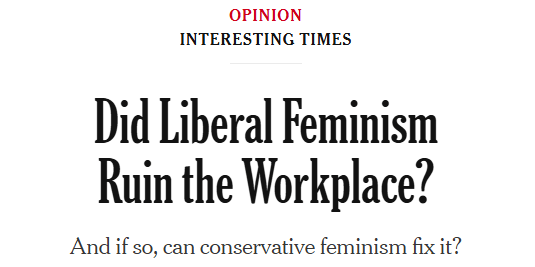
A recent, provocative headline in The New York Times asked if feminism ruined the workplace.
This question is fundamentally flawed. It’s a distraction that points the finger at a group of people instead of at the systems that weren’t built for everyone. It invites us to debate which type of person is problematic, rather than asking the far more useful question: Why do our workplaces still generate so much friction for so many people?
The problem isn’t, and has never been, a specific identity. There is nothing inherently wrong with any gender, race, or background.
The problem is the rigid, narrow, and often unspoken expectations our workplace systems have bolted onto the concept of an ideal employee—expectations that have been unreasonably tied to gender, race, disability status, communication style, and cultural background. For decades, the default operating system for success was based on a very specific archetype—an in-group. This created a set of invisible rules about what a leader looks like, how a leader sounds, and how a leader acts.
This is what I call Leadership Friction.
It’s the invisible, systemic force that creates drag on individuals and organizations. It’s the tax paid by anyone and everyone who doesn’t perfectly align with that default in-group model.
And this friction isn’t just paid by those whose authentic style doesn’t match the default. It’s also paid by those in the in-group who, operating from a different starting point, often can’t see or understand the friction points that are painfully obvious to others. This creates massive organizational blind spots, miscommunication, and inefficiency, where countless hours are wasted managing misalignment that stems from these different, unexamined experiences.
Leadership Friction is the invisible battle a leader from an out-group fights when their confidence is called aggression while the in-group standard is called authoritative. It’s the unrewarded glue work disproportionately shouldered by those expected to be collaborative, work that is critical for team cohesion but mysteriously absent from performance reviews. It’s the constant, exhausting background process of having your competence questioned in ways others are not.
This friction is the real saboteur. The true ruin isn’t that diverse professionals are in the workplace. The ruin is the staggering amount of energy, talent, and innovation we waste navigating this friction.
Think of the sheer volume of brilliance that is lost—not to a lack of skill, but to Environmental Exhaustion. This is the exhaustion that comes from pushing against a system that was simply not built for you. It’s the exhaustion that leads your most indispensable, high-impact Keystone Leaders to a stay or go crossroads, not because they can’t do the job, but because they are tired of paying the friction tax required to do it.
Bringing a diversity of people into the workplace didn’t ruin it. It simply held up a mirror and exposed the systemic friction that was already there, slowing everyone down. The discomfort some feel isn’t from the ruin; it’s from the revelation.
Stop asking if any group ruined the workplace. Start asking how we can finally address the systemic friction that drains our best people. The goal isn’t to fix people to fit the system. The goal is to diagnose the system and equip all leaders with the tools to navigate it, turning that friction into strategic leverage for themselves and their organizations.
That is how you build a workplace that doesn’t just survive, but thrives.
This is a conversation I’m passionate about, and I’ve just posted this article over on LinkedIn to get a wider discussion going.
My question for you is: How much of your team’s energy is spent navigating friction versus doing the work?
I’ll also be exploring these themes in person this week (Nov 19-21) at the PASS Data Summit in Seattle. If you’ll be there, please find me at my talk, “I got the role… Now what?”, or at the Community Experts Clinic.
With dragonfire warmth and enduring wisdom, Cindy Gross | Founder, Befriending Dragons | Your Leadership Navigation Coach 🐉 https://befriendingdragons.com
Last week I had one of those rare evenings that fills your cup in the best way.
I went with my friend and longtime collaborator Moni Giles, who’s doing powerful work around belonging and emotional intelligence through The Friendship Class. We showed up excited and ready to expand our networks.
We stepped into a room buzzing with powerhouse women—leaders, creatives, and equity-driven changemakers all showing up real, raw, and ready to connect. It felt like a deep exhale. A reminder that I’m not alone in wanting more from leadership—more authenticity, more impact, more alignment.
The event, hosted by Ellevate Seattle, was centered around mobilizing our networks—and it truly delivered. The space was built for meaningful conversation and real connection, not just small talk and drinks.
That’s the heart of what I do through Befriending Dragons.
I deliver a highly rated 1:1 coaching experience for women and non-binary leaders who are done performing and ready to reshape leadership on their own terms.
Here’s what we work through:
1. Name What’s True: We take stock. What are you done with? What’s calling to be reclaimed? This is your foundation.
2. Befriend the Dragons: Your patterns and instincts aren’t problems—they’re data. We learn how to work with them, not against them.
3. Integrate & Embody: You build your Dragon Playbook—your personal “Operating System of Me”—and start applying it in real-life moments of leadership, boundaries, and clarity.
4. Return & Realign: We reflect, recalibrate, and make sure what you’ve built is sustainable—even when life gets loud again.
And if you’re thinking about asking your org to cover the cost, I’ve got a clear ROI doc you can use—just reply and I’ll send it your way.
P.S. You don’t have to be in tech to be a fit for Dragon Path. If this message resonates, let’s talk. My mission is to be inclusive and bring more folks forward into thriving.
With dragonfire warmth and enduring wisdom, Cindy Gross Founder, Befriending Dragons Your Leadership Clarity Coach 🐉 https://befriendingdragons.com
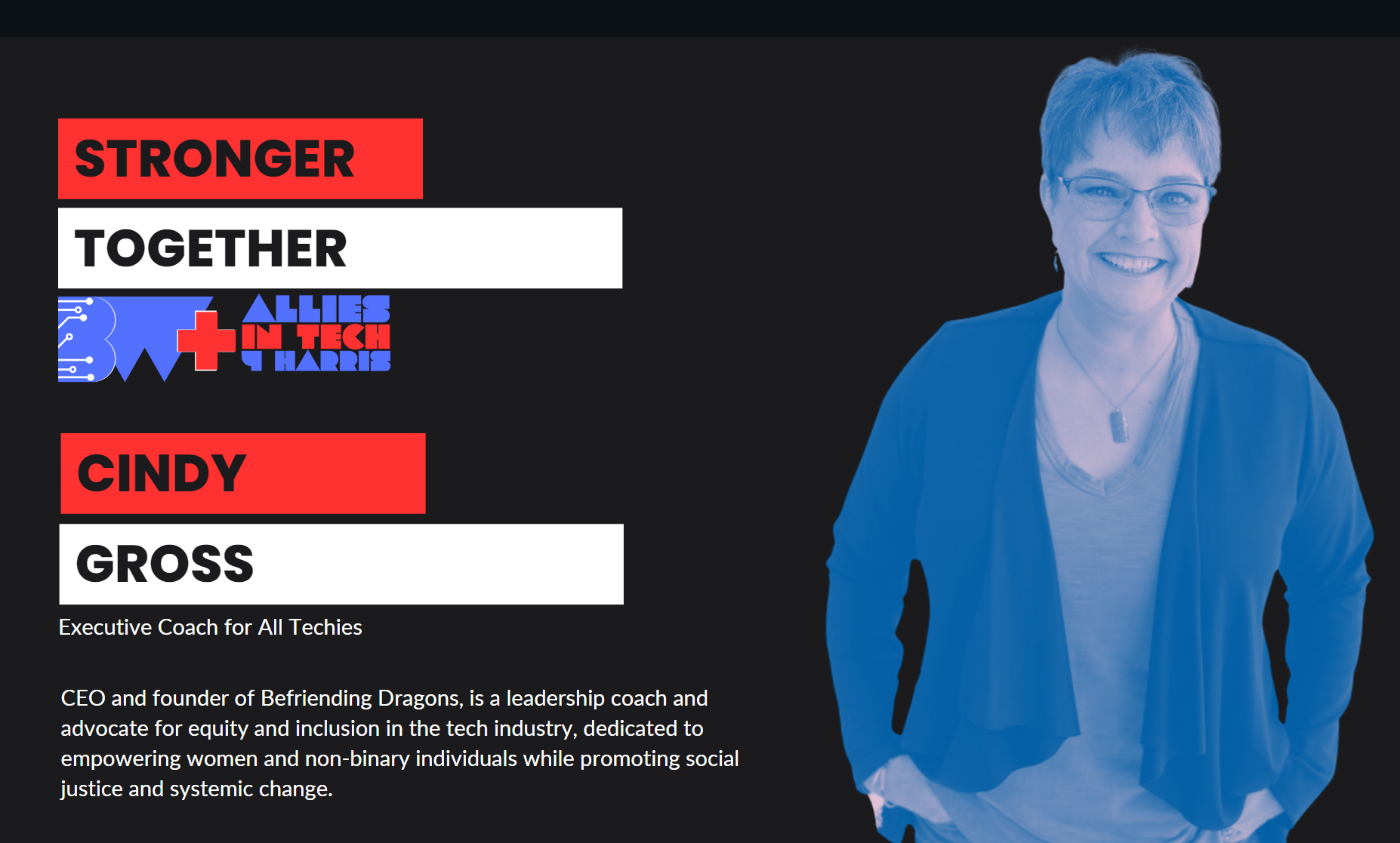
August 2024: I harnessed my inner fire to influence the direction of the tech industry and of our country. I spoke at the Stronger Together: Black Women and Allies in Tech 4 Harris Virtual Summit. Wow – so many powerful folks speaking about our experiences working in tech, how our workplaces and careers are heavily influenced by who is in elected offices, and our dreams for the future! We cannot achieve true equity until we address the systemic barriers that Black women and other women of color face every day – in tech, in our culture generally, and in this presidential race. Why am I talking about politics when this newsletter is about leadership, the tech industry, and careers? Because tech will be more innovative, equitable, and FUN when we elect Kamala Harris. Read more about the impact from this call.
Here’s what I shared at the event (starting at 44:43 in the recording):
It’s an honor to be here today, standing alongside such a powerful community of Black women and allies in tech.
As someone who navigated the tech industry for over 25 years, I’ve seen firsthand the challenges and triumphs that come with being a woman in a male-dominated field. My journey has been shaped by the support and solidarity of communities like this one, and by the belief that together, we can create a more inclusive and equitable tech landscape.
Too many times I was the only woman in the room, and I can’t remember a time when another Native American person was in a work meeting with me. One time, full of excitement, I came to a team meeting and told my boss that I had two women candidates for our open position and his instinctive, immediate response was to tell me “we won’t lower the bar for them.” Picture that — he meant the bar was lowered to let ME in, right? But really nothing was lowered, because the bar is shaped like a white man, with irrelevant gates that exclude so many qualified people, or cut us deeply as we fight our way in. It was a stark reminder of the bias that persists in our industry – and in our elections. It was a turning point for me. I realized that my voice, and the voices of other marginalized individuals, needed to be amplified, we will no longer be silenced.
This experience fueled my passion to advocate for women and non-binary individuals in tech. It deepened my commitment to racial equity, because I understand that the fight for gender equality is intrinsically linked to the fight for racial justice. We cannot achieve true equity until we address the systemic barriers that Black women and other women of color face every day– in tech, in our culture generally, and in this presidential race.
Today, we have an opportunity to make a significant impact. Vice President Kamala Harris has been a steadfast advocate for equity and justice. Her leadership and policies reflect the values we hold dear – values of justice, equity, and belonging, and the belief that everyone deserves a decision-making seat at the table. And to continue this work, HARRIS needs our support.
So many techies have six-figure salaries – I urge each of you to dig deep into your pockets with that in mind and contribute to her campaign. Yes, money is tight for everyone AND often tech rewards us far better than it does people in other industries. Your contributions help ensure that we have leaders who understand the importance of equitable tech policies and who are committed to driving systemic change. Donate, vote, and talk to at least 3people about registering to vote plus a plan on how they will turn in their vote.
Together, we can build a tech industry that not only welcomes but celebrates diversity. WE can create environments where everyone, regardless of their race or gender, can thrive. Let’s stand strong, support Kamala Harris, and continue to push for the inclusive and equitable future we all deserve.
Last week @VeniKunche tweeted asking for “remote work” tips for managers. I immediately replied with a whole string of tips that reduce bias. Veni said, hey, blog that. And I thought, sure, that’s easy. And yet here it is, days later, and I hadn’t written much more than a paragraph until I accepted Amy Cuddy’s invite to Quarantine Writing Hour. I can literally feel the anxiety sitting in my chest, aching. Folks, this is what it’s like to work during a crisis, personal or global. It’s not because I’m remote, it’s not because no one is watching over my shoulder with an eye to punish lowered productivity. It’s because we’re stressed, we’re worried about family and friends and the future of the world, we are fidgety, we miss our community, we are overwhelmed. Luckily I’m not feeling sick, but many are and without sufficient testing we don’t know who actually has COVID-19.
Some of us have done remote work for a while, some are completely new to the experience. As the need to maintain “social distance” grows with the spread of COVID-19 there are fountains of advice on the practical aspects of how to work remotely. But what about the social justice and leadership aspects? How do we keep bias and bullying from creeping into every aspect of working remotely? How does this impact various folks differently? How do we take advantage of this social disruption to drive positive changes into our workplace, changes that could linger long after the novel Coronavirus is under control?
The reasons it took me so long to write this story are the same reasons we can’t expect high productivity out of people working from home right now. It’s not the working from home part. It’s the stress of working in an unfamiliar environment, underprepared, while we’re worried about everything. Many folks have unfamiliar, inadequate equipment in a home where they may also be caregivers for other stressed out folks. There may not be enough devices, internet bandwidth, or “included” data for everyone to work and learn at once. We may not have physical or emotional safety.
Kindness
“You can be rich in spirit, kindness, love and all those things that you can’t put a dollar sign on.” — Dolly Parton
Change causes stress. Even when we’re able to use stress to push us forward, it can still negatively impact our lives. So prioritize kindness over niceness and politeness.
Center the folks most marginalized on your team, and do all you can to uplift them even if means making other folks uncomfortable when you point out bias. Don’t tolerate COVID-19 jokes, insensitive comments that trivialize the danger to the most marginalized, or point blame at Asian people. Practice now how you will reply to anyone making ableist, racist, or sexist comments.
Where’s the bias?
“The defining question is whether the discrimination is creating equity or inequity. If discrimination is creating equity, then it is antiracist. If discrimination is creating inequity, then it is racist.” — Ibram X. Kendi, How to Be an Antiracist
Well, women and people of color are much more likely to be caregiving than white men are, and that takes time and energy. We’re crowded into unfamiliar situations where we have to navigate all sorts of family dynamics that we’re not used to, and typically that will fall mostly to one person, using up their already limited energy. As somebody living alone with my cats, I’m also going through this chaos because I’m fielding calls and messages from friends and family with problems they need help with, things I may or may not be able to help them with. I get really stressed when I can’t help people who need me! I’m constantly bombarded with news snippets and feeling compelled to dig deeper, because my curiosity is always in the forefront of my actions and there’s so much new, vital, literally life or death information ALL THE TIME. That makes us less productive – don’t penalize that right now!
Women, especially BIPOC, are more likely to be cooped up for days on end with an abuser, to have lower savings (hey, pay gap!), to be expected to deal with everyone else’s stress, to rely on a community that is now less available, and all those other inequities we’ve been talking about and doing so little to actual address.
When we’re stressed or short on time we fall back on deeply embedded patterns, and that means we rely more on stereotypes and bias. We have to be very intentional to pay attention to this and compensate for the bias that will ALWAYS creep in.
The Tweets aka the Advice
I’m going to make this ultra-simple on myself, I’m going to paste below my replies to Veni’s tweet. I welcome comments and questions.
The manager should set the tone by remaining connected without hovering. Offer to remove roadblocks, be patient, let folks have uninterrupted time to focus on work. Recognize many of these folks have no choice but to also caregive during the work day.
Some of your employees are going to spend a whole lot of time in enforced close proximity to their abuser. Some are the abuser, perhaps triggered by stress and frustration. Be kind.
Not everyone has enough bandwidth, may face a datacap. They may not have great, fast devices at home, may have to share one pc. They may have many folks in the house streaming classes, meetings, large files. Keep your emails and optional files simple & small.
Folks react differently to isolation. Offer but don’t force virtual coffees, open “water cooler” zoom calls where people can come & go, gracious space questions for folks to reflect on how they are creating success in chaos with a focus on finding the ways they are doing great.
Put on your anti-bias hat. Don’t over-reward the folks who over deliver during this time. They will be disproportionately white men because that’s how our white patriarchy is set up. Statistically men have more flexible schedules & fewer child/elder care duties.
All sorts of biases will be exaggerated as everyone is under pressure, managers have to be extra careful to be great allies. Ppl who aren’t white may not always code switch at home the way they do at work. You may see more of their authentic self – reward this, don’t punish it.
Remember at review/reward/promo time that this virus has disrupted the year. Highlight & reward folks who build strong relationships, strong containers, strong stakeholder outreach. A lot of “soft skills” that ppl who aren’t white men have to develop to survive can be showcased.
Change is everywhere right now, fill the cracks with anti-bias. This is hard work, but may actually be easier since disruption is already on full swing. Rebuild with anti-bullying and anti-bias.
Managers, now is the time to bring in folks like Veni or me or any of the myriad of anti-bias, pro-belonging, pro-DEI folks to take hold of this disruption in work life and come out the other side stronger. #BefriendingDragons
And some tweets from other threads
Now is a perfect time to let go of your need for the purity of perfection. https://t.co/X2dlloSYWk
I've been gradually more productive as I continue my detox from corporate tech. Until now. I'm back to total inability to focus, make decisions, and get started on anything. Stress is real y'all, don't penalize your employees who are stressed and exhausted. Health > productivity
Be kind. Center the most marginalized over the most powerful. Be anti-bullying, anti-harassment, anti-racist, & anti-sexist.
Going forward, allow more folks to work from home regularly without penalty. This disproportionately helps folks with disabilities and those who are caregivers. It builds trust and refocuses everyone on the work. It’s good business, good for your employees, and good for the environment.
Look for the helpers – Fred Rogers
Pledge to really work hard to address the bias head-on in your next round of reviews and/or rewards. Don’t reward productivity in and of itself. Reward those who help others through this, who build and nurture relationships, who reduce other people’s stress and tension. Those people are the true leaders.
Want receipts on these bias factors? Search on terms like:
This year’s Boise Code Camp has an exciting new panel session: “Where are the Women in Technology?” We have a great lineup of women who will help us all understand why women in tech matter to your bottom line. The panel invites everyone of any gender to attend and learn more about how we can all help make our businesses more productive, our work culture more pleasant, and our employees and coworkers happier. The session is sponsored by “Girl Develop It! Boise”.
Saturday, March 21 at 140p at the BSU Special Events Center
How does it impact you and your business when women are underrepresented in your tech department? Women are interested, why aren’t they working in IT? Why is the number of women in IT decreasing? What can you personally do about it? Why should you care? We can all help make our businesses more productive, our work culture more pleasant, and our employees and coworkers happier. Sponsored by “Girl Develop It – Boise”.
We frequently hear how Idaho wants to be seen as a top tech destination. We want to attract new startups as well as existing businesses. Women are an untapped resource that can help make that happen. When women join boards and hold decision making positions in businesses, those businesses tend to outperform businesses with fewer women. Having a pipeline of women techies coming out of our local universities and a workforce with a high percentage of techie women can help attract high tech businesses. Tech businesses historically have a big focus on diverse workforces since over the years they’ve seen the benefits of having a multitude of perspectives when developing new products and services. Women are leading adopters of new products and services, it just makes sense to have women adding a female viewpoint to the decision making process as those products and services are chosen and built.
While tech businesses value women, they still see women exiting the field at much higher rates than men. Take game development as an example. Sexism, misogyny, and sexual harassment are worse in the areas of tech that traditionally are even more overwhelmingly male than most – like video game development. While nearly half of women who play games are women, many games are marketed with ads that emphasize women as sex objects and few games have female avatars to choose from. When female characters or avatars are present in a game they generally have a much more limited range of body types with an emphasis on highly sexualized looks. Again, that is usually attributed to the fact that most of the people who write and market games are men – they never even question what they are doing, it’s just accepted. There is an unproven assumption that women will play “boy games” but men won’t play “girl games”. Female gamers like panelist and IT veteran Jane Miceli are asked “are you really a girl?” when they play well and score high in an online game. When more women are hired into gaming companies/divisions the products change. More non-sexualized female characters appear. Games begin to have more layers to them, more ways of interacting. And then more people buy those games. That’s good for business.
When women are mentored, encouraged, and valued at work they help drive better business decisions.
The Panelists
Our panelists include three women representing a range of IT career stages. Kelsey Suyehira is a BSU senior with a math degree who has returned to school to get a degree in computer science. She is currently president of the Association for Computing Machinery Women’s group, a club that supports the recruitment and retention of women in computer science on campus. Suyehira is joined on the panel by Marianna Budnikova, a professional hacker at the locally owned MetaGeek. In addition to her passion for machine learning and genetic algorithms, which were the basis of her Master’s thesis, Budnikova loves to develop iOS and Android apps. Rounding out the techies on the panel is Jane Miceli. Miceli is a 15 year veteran of the IT industry and a SCRUM Master with a Master’s degree in computer science. She is an avid supporter of tech education and ongoing volunteering on the Idaho Technology Council’s Education Committee, Boise School District’s First Robotics Team 2122, the annual Boise Code Camp conference. Miceli is also managing director for Girls In Tech Boise. All three women show their leadership skills in the Boise chapter of Girl Develop It – a nonprofit that offers affordable technology classes to women through introductory classes such as Python, HTML, and Hadoop. These female tech leaders will talk about their personal experiences with being a woman in tech.
The panel is rounded out by two BSU gender studies lecturers. Carrie Semmelroth lectures on early and special education and gender topics at BSU. Semmelroth spends much of her time on data analysis in her department which gives her an interesting perspective on the intersection of gender and technology. Representative Melissa Wintrow is an educator, trainer, and leadership consultant who lectures on gender studies. Wintrow has been elected to represent District 19 in the Idaho legislature. Semmelroth and Wintrow will bring their perspectives as leaders and educators to help us understand how we can each have a positive impact at work.
Panel moderator Cindy Gross is a long time IT veteran with a passion for changing the way businesses do business, whether that’s through adoption of new technologies such as Hadoop or by increasing diversity in the workplace. Gross looks forward to a great hour of discussion on a range of Women in Tech topics that take us from a view of today’s reality to concrete, real-world actions that each of us can take to attract and retain more women in technology. The panel invites live tweeters to use the hashtag #BoiseWIT when discussing the session.
We Need More Women in Tech: The Data Prove It http://www.theatlantic.com/technology/archive/2013/10/we-need-more-women-in-tech-the-data-prove-it/280964/ “In 2010, although 57 percent of undergraduate degree recipients were female, but only 14 percent of the computer science degrees at major research universities. Incredibly, this number has actually fallen in recent years: In 1985, 37 percent of undergraduates degree recipients in computer science were women. By 2010, that fell to 18 percent, and at major research universities, the number was 14 percent.”…”[W]omen-operated, venture-backed high tech companies average 12 percent higher annual revenues. They also use on average one-third less capital than male counterparts’ startups.”
Why Women Quit Technology http://www.computerworld.com/article/2551969/it-careers/why-women-quit-technology.html “63% of women in science, engineering and technology have experienced sexual harassment… If a man fails, his buddies dust him off and say, “It’s not your fault; try again next time.” A women fails and is never seen again. A woman cannot survive a failure.”
Add the 4 Words supporters being arrested and transported from the Statehouse to the Ada County Jail. Photo by Ashton Page.
I believe in justice. I believe in human rights. I believe gay rights are human rights. I believe the Equal Protection Clause of the 14th Amendment to the US Constitution guarantees “Equal Justice Under Law”. Idaho is keeping that justice from an entire group of people – those who are gay. Gay teens in Idaho are bullied into suicide. Gay teens and adults are denied jobs or promotions. Gay folks can’t take a picture of their partner to work. Straight employees can’t take pictures of their gay adult child and that child’s partner to work. People of all orientations avoid taking jobs in Idaho or refuse to bring their businesses here because they worry about their families. What do you believe in? What are you willing to do in support of those beliefs?
I am willing to fight for what is right, to fight for everyone of every sexual orientation and every gender identity. Last week I chose to be arrested, along with 45 other supporters, in support of the “Add the 4 Words” cause. The Republican Leadership in the Idaho legislature won’t even hold a hearing to listen to the stories of those who face discrimination for their real or perceived sexual orientation – and we all have a sexual orientation. We have lobbied legislative leadership, shared poll results showing a vast majority of Idahoans across the state believe firing someone just because they are gay is wrong, and told them our personal stories. Yet still leadership silences our voices, ignores their constituents, and refuses to hold a public hearing where their own constituents could testify. What do you believe in? What are you willing to do in support of those beliefs?
With the support of former Idaho Governor and former head of the Idaho Republican Party Phil Batt, in the 1960s Idaho added a Human Rights Act. We simply want to Add the Words “sexual orientation” and “gender identity” to that existing act to tell Idahoans that gay folks get the same basic human rights as the rest of us. Former Governor Batt supports this modification to the act he helped create – he wants his gay grandson to feel safe while visiting Idaho. He calls the current legislature’s failure to act “disdain.” What do you believe in? What are you willing to do in support of those beliefs?
You can spend a few minutes or a few hours or a few days on an action – start as small as you want. Do one action or many. Just do something. Stand up for your beliefs, for the fact that all humans deserve basic dignity and respect and the freedom pursue their happiness. Start with any one of the items below. See how that feels. And come back for more when you’re ready. What do you believe in? What are you willing to do in support of those beliefs?
Cindy Gross – Arrested in support of Add the Words, Idaho Feb 27, 2014. What will you do? Photo by Ada County Sheriff Deputies.
1) Tell Governor Otter your thoughts on Idaho’s reputation with regards to human rights, especially gay rights. This is even more important for those of you don’t live in Idaho. Would you visit Idaho? Would you start a business here? Would you bring your family here for a job? Give him a personal story.
2) Follow @AddTheWords and @AddThe4Words on Twitter. Now tweet why you support gay rights in Idaho and tag one or both of those accounts. Consider tagging Governor Otter, Senator Hill, your own legislators, or national folks who we may be able to engage in the cause.
3) Donate to Add the 4 Words to help cover the bail and fines of those standing up to be arrested.
5) Sign up to participate in in the next Add the 4 Words arrest action – you don’t have to be arrested, you can volunteer as an observer or supporter.
6) Contact your Idaho State Senator and two Idaho State Representatives plus Senator Brent Hill. Note that this is NOT the same as your US Senators (Crapo and Risch) and US Representatives (Labrador and Simpson). There are 35 districts in Idaho – there are many different legislators. I am happy to help you figure out who to contact (cgross1@hotmail.com).
7) Tell your friends why you believe Add the Words is the right thing to do.