Cindy Gross presented Coaching for Race and Gender Equity as part of ICF International Coaching Week. Grounded in the Cherokee concept of Gadugi—working collectively toward a shared purpose—Cindy explored how coaches can actively disrupt racial and gender inequities. She discussed strategies for helping clients navigate inequitable systems, reducing unintentional harm, and creating lasting systemic change. By fostering psychological safety and inclusion, coaches can support underrepresented voices while challenging white supremacy and patriarchy in workplace dynamics.
Cindy Gross Featured on The Roller Coaster of Midlife with Lucie Q
Cindy Gross joined Lucie Q’s podcast, The Roller Coaster of Midlife, to discuss navigating career pivots, resilience, and embracing change in midlife. In the episode Midlife Pivots with Cindy Gross, she shared her journey—from overcoming workplace challenges to redefining success on her own terms.
Cindy explored themes of breaking gender stereotypes, setting boundaries, and transforming setbacks into opportunities. Her insights offer inspiration for those looking to reclaim their narrative and step into a more empowered chapter of their lives.
Listen in to gain practical strategies for navigating career and life transitions with confidence!
Cindy Gross Featured on Lisa’s Podcast: Grace, Grit, Getting it Done!
Cindy Gross joined Lisa Gillette’s podcast, Grace, Grit, Getting it Done! to discuss empowering women in tech and navigating workplace culture with confidence. In the episode Befriending Dragons: Empowering Women in Tech to Navigate Work Culture with Confidence, Cindy shared insights from her own career in tech and her work as a Women in Tech Leadership Coach.
She explored key strategies for setting boundaries, claiming opportunities, and owning one’s value in a male-dominated industry. This conversation is a must-listen for anyone looking to thrive professionally while fostering self-assurance and advocacy.
Catch the episode and gain practical insights into building a fulfilling and impactful career in tech with Cindy’s expert guidance!
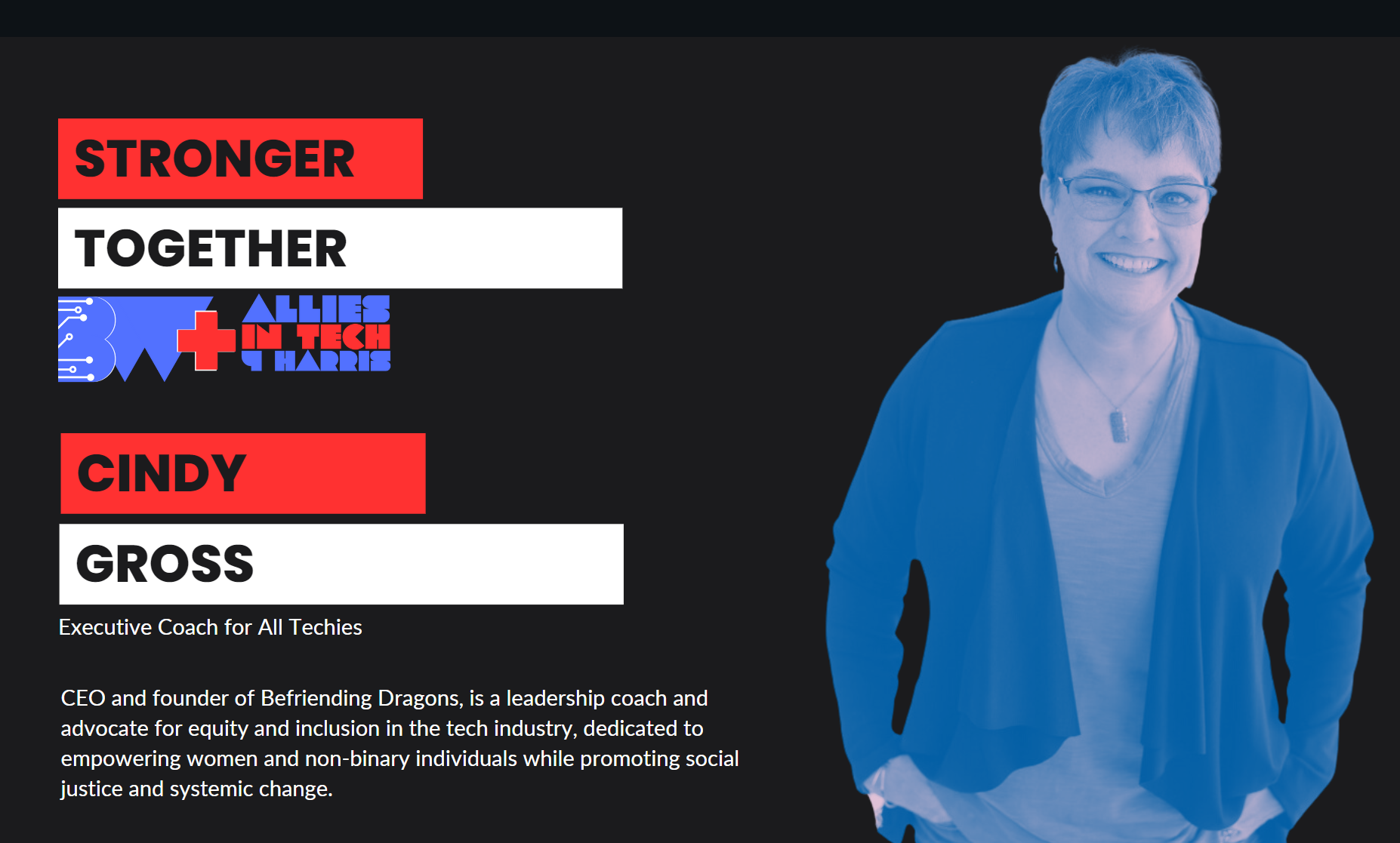
August 2024: I harnessed my inner fire to influence the direction of the tech industry and of our country. I spoke at the Stronger Together: Black Women and Allies in Tech 4 Harris Virtual Summit. Wow – so many powerful folks speaking about our experiences working in tech, how our workplaces and careers are heavily influenced by who is in elected offices, and our dreams for the future! We cannot achieve true equity until we address the systemic barriers that Black women and other women of color face every day – in tech, in our culture generally, and in this presidential race. Why am I talking about politics when this newsletter is about leadership, the tech industry, and careers? Because tech will be more innovative, equitable, and FUN when we elect Kamala Harris. Read more about the impact from this call.
Here’s what I shared at the event (starting at 44:43 in the recording):
It’s an honor to be here today, standing alongside such a powerful community of Black women and allies in tech.
As someone who navigated the tech industry for over 25 years, I’ve seen firsthand the challenges and triumphs that come with being a woman in a male-dominated field. My journey has been shaped by the support and solidarity of communities like this one, and by the belief that together, we can create a more inclusive and equitable tech landscape.
Too many times I was the only woman in the room, and I can’t remember a time when another Native American person was in a work meeting with me. One time, full of excitement, I came to a team meeting and told my boss that I had two women candidates for our open position and his instinctive, immediate response was to tell me “we won’t lower the bar for them.” Picture that — he meant the bar was lowered to let ME in, right? But really nothing was lowered, because the bar is shaped like a white man, with irrelevant gates that exclude so many qualified people, or cut us deeply as we fight our way in. It was a stark reminder of the bias that persists in our industry – and in our elections. It was a turning point for me. I realized that my voice, and the voices of other marginalized individuals, needed to be amplified, we will no longer be silenced.
This experience fueled my passion to advocate for women and non-binary individuals in tech. It deepened my commitment to racial equity, because I understand that the fight for gender equality is intrinsically linked to the fight for racial justice. We cannot achieve true equity until we address the systemic barriers that Black women and other women of color face every day– in tech, in our culture generally, and in this presidential race.
Today, we have an opportunity to make a significant impact. Vice President Kamala Harris has been a steadfast advocate for equity and justice. Her leadership and policies reflect the values we hold dear – values of justice, equity, and belonging, and the belief that everyone deserves a decision-making seat at the table. And to continue this work, HARRIS needs our support.
So many techies have six-figure salaries – I urge each of you to dig deep into your pockets with that in mind and contribute to her campaign. Yes, money is tight for everyone AND often tech rewards us far better than it does people in other industries. Your contributions help ensure that we have leaders who understand the importance of equitable tech policies and who are committed to driving systemic change. Donate, vote, and talk to at least 3people about registering to vote plus a plan on how they will turn in their vote.
Together, we can build a tech industry that not only welcomes but celebrates diversity. WE can create environments where everyone, regardless of their race or gender, can thrive. Let’s stand strong, support Kamala Harris, and continue to push for the inclusive and equitable future we all deserve.
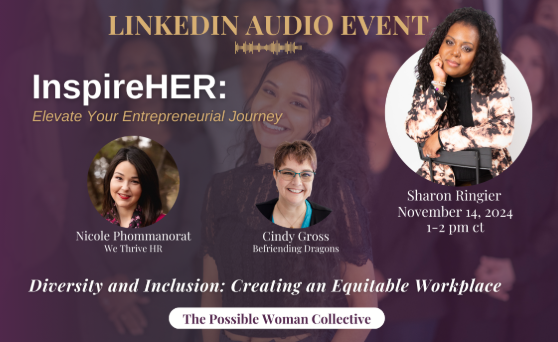
Cindy Gross was a speaker at InspireHER: Elevate Your Entrepreneurial Journey, where she shared insights on inclusive leadership and fostering a workplace culture of belonging and psychological safety. Her approach goes beyond surface-level DEI efforts, helping organizations embed inclusion into their core values. If you’re looking to understand Cindy’s perspective and expertise as a leadership coach, this past event is a great opportunity to listen in and learn more.
Befriending the dragons lounging on my pile of emails
It’s time for an inbox cleanse. I do this periodically, and it never lasts. I can get close to the coveted “inbox zero” for a few days, and then it creeps back up. I’ve tried tools and techniques and timers and rules…. And still several times this year I’ve had many thousands of emails in my inbox. I can just see my inner dragons settling comfortably on top of the hoard of emails, nestling in and getting comfortable.
Zeke the dragon…. er… orange cat lounging in a box where he doesn’t belong.
So as a generative coach, how do I coach myself to deal with this? I’ll walk you through my internal dialogue and how I got to my current system where as I wrap up this workday I have only 3 emails in my inbox.
How do I feel when I look at my overflowing inbox?
Overwhelmed.
What has worked for me in the past when I feel that way?
Break down the problem into smaller pieces and focus on the impact I want to have. Then I can choose the actions that lead to that impact. For email I’ve already set up a handful of inbox subfolders and rules to direct incoming emails to them and I frequently unsubscribe to newsletters. I overcommit by adding new things to my self-imposed “to do today” list even if I know I can’t get it done that day, and that list is a combo of my inbox, tasks I add to my calendar, and a piece of paper. Basically I’m using my inbox as a set of reminders.
What patterns do I see here?
This is interesting. I often repeat the pattern that discomfort is my comfort zone. I also still get caught in the corporate mindset that I need to have an overfull plate to be taken seriously. Even deeper though, it comes down to a fear of both failure and success. If I focus on the most important things, then my fledgling business is out there in the wild, and I don’t know what will happen. Will people want to work with me? Will I be able to sustain the business both from a personal energy perspective and financially? If it’s successful then…. what? Lots of unknowns that are scary for a whole variety of reasons. Basically having those emails sitting there in my inbox lets me use them as an excuse to avoid dealing with my feelings and to have an excuse for going slow.
What keeps me from taking my next step forward?
As I go through the older emails I am revisiting my past. I’m reminding myself of the missed opportunities, the events I planned to go to and forgot about, the people I didn’t connect with, the idea I did nothing with. The successes were filed away, the failures await me.
And the newsletters, there are so many. This feels like superficial community building, a way to show support, learn from others, and identify potential partners – but it’s not any of those things if I don’t engage beyond subscribing. It scatters my focus and leaves me grasping at shiny objects, just like a dragon adding every bauble in sight to its hoard.
What first step will I take to move forward?
Start with a clean slate. Create a sustainable framework to deal with new calls for my attention, in this case incoming emails.
Will I commit to creating and implementing this framework today? What do I get out of that?
Yes. This will help me stay future-focused and be more intentional in how, how fast, and where to move forward. I’ll focus my internal dragons on my dreams.
My inbox framework
Move all 2000+ inbox emails to a new subfolder under my inbox called __CleanMeUpNow.
I thought it would take me weeks or months to go through the cleanup folder, but in a few hours spread over three days I went from well over 2000 emails to around 150. I sorted by who they were from and deleted many of them in chunks. Many got filed, many more got deleted. I utilized a bunch of “unsubscribe” links.
About a week later I went through every remaining email in the cleanup folder and I’m down to 34. All of them are ideas for creating content like this blog, people I want to connect with, or business building ideas. In other words it’s useful to have that information, and I’ll decide later if there’s another way I want to track those ideas. I don’t have to do it all today.
Deal with new emails a few times throughout the day. Yes, I know some frameworks have other opinions on how often to read new emails. This is what works for me.
Reply or schedule or file.
Ruthlessly unsubscribe. If I find I resist unsubscribing, see how I feel about creating a rule to move it to the “to read” folder that never gets read. Hey, don’t laugh. It works. If I need to ponder more, move it to the cleanup folder. I’m surprised how rarely I need to park emails in the cleanup folder
Post business or partnership ideas to my business notebook in OneNote and file or delete the email.
Give myself 15-30 minutes max at the end of the day to get my inbox to fit on a single screen, about 8-10 emails. I just checked my inbox and realized I had tasks on my calendar to verify two of them are complete by next week (I’m waiting on others) and filed those. That leaves me with one email to address tomorrow!
This is so exciting. I feel lighter and energized! What gets in your way and how will you move forward?
I hope you enjoy this latest Befriending Dragons nugget! Check out my coaching programs and individual sessions. I love to make new connections – please schedule a 15-30 meeting if something I said here resonates with you.
Last week @VeniKunche tweeted asking for “remote work” tips for managers. I immediately replied with a whole string of tips that reduce bias. Veni said, hey, blog that. And I thought, sure, that’s easy. And yet here it is, days later, and I hadn’t written much more than a paragraph until I accepted Amy Cuddy’s invite to Quarantine Writing Hour. I can literally feel the anxiety sitting in my chest, aching. Folks, this is what it’s like to work during a crisis, personal or global. It’s not because I’m remote, it’s not because no one is watching over my shoulder with an eye to punish lowered productivity. It’s because we’re stressed, we’re worried about family and friends and the future of the world, we are fidgety, we miss our community, we are overwhelmed. Luckily I’m not feeling sick, but many are and without sufficient testing we don’t know who actually has COVID-19.
Some of us have done remote work for a while, some are completely new to the experience. As the need to maintain “social distance” grows with the spread of COVID-19 there are fountains of advice on the practical aspects of how to work remotely. But what about the social justice and leadership aspects? How do we keep bias and bullying from creeping into every aspect of working remotely? How does this impact various folks differently? How do we take advantage of this social disruption to drive positive changes into our workplace, changes that could linger long after the novel Coronavirus is under control?
The reasons it took me so long to write this story are the same reasons we can’t expect high productivity out of people working from home right now. It’s not the working from home part. It’s the stress of working in an unfamiliar environment, underprepared, while we’re worried about everything. Many folks have unfamiliar, inadequate equipment in a home where they may also be caregivers for other stressed out folks. There may not be enough devices, internet bandwidth, or “included” data for everyone to work and learn at once. We may not have physical or emotional safety.
Kindness
“You can be rich in spirit, kindness, love and all those things that you can’t put a dollar sign on.” — Dolly Parton
Change causes stress. Even when we’re able to use stress to push us forward, it can still negatively impact our lives. So prioritize kindness over niceness and politeness.
Center the folks most marginalized on your team, and do all you can to uplift them even if means making other folks uncomfortable when you point out bias. Don’t tolerate COVID-19 jokes, insensitive comments that trivialize the danger to the most marginalized, or point blame at Asian people. Practice now how you will reply to anyone making ableist, racist, or sexist comments.
Where’s the bias?
“The defining question is whether the discrimination is creating equity or inequity. If discrimination is creating equity, then it is antiracist. If discrimination is creating inequity, then it is racist.” — Ibram X. Kendi, How to Be an Antiracist
Well, women and people of color are much more likely to be caregiving than white men are, and that takes time and energy. We’re crowded into unfamiliar situations where we have to navigate all sorts of family dynamics that we’re not used to, and typically that will fall mostly to one person, using up their already limited energy. As somebody living alone with my cats, I’m also going through this chaos because I’m fielding calls and messages from friends and family with problems they need help with, things I may or may not be able to help them with. I get really stressed when I can’t help people who need me! I’m constantly bombarded with news snippets and feeling compelled to dig deeper, because my curiosity is always in the forefront of my actions and there’s so much new, vital, literally life or death information ALL THE TIME. That makes us less productive – don’t penalize that right now!
Women, especially BIPOC, are more likely to be cooped up for days on end with an abuser, to have lower savings (hey, pay gap!), to be expected to deal with everyone else’s stress, to rely on a community that is now less available, and all those other inequities we’ve been talking about and doing so little to actual address.
When we’re stressed or short on time we fall back on deeply embedded patterns, and that means we rely more on stereotypes and bias. We have to be very intentional to pay attention to this and compensate for the bias that will ALWAYS creep in.
The Tweets aka the Advice
I’m going to make this ultra-simple on myself, I’m going to paste below my replies to Veni’s tweet. I welcome comments and questions.
The manager should set the tone by remaining connected without hovering. Offer to remove roadblocks, be patient, let folks have uninterrupted time to focus on work. Recognize many of these folks have no choice but to also caregive during the work day.
Some of your employees are going to spend a whole lot of time in enforced close proximity to their abuser. Some are the abuser, perhaps triggered by stress and frustration. Be kind.
Not everyone has enough bandwidth, may face a datacap. They may not have great, fast devices at home, may have to share one pc. They may have many folks in the house streaming classes, meetings, large files. Keep your emails and optional files simple & small.
Folks react differently to isolation. Offer but don’t force virtual coffees, open “water cooler” zoom calls where people can come & go, gracious space questions for folks to reflect on how they are creating success in chaos with a focus on finding the ways they are doing great.
Put on your anti-bias hat. Don’t over-reward the folks who over deliver during this time. They will be disproportionately white men because that’s how our white patriarchy is set up. Statistically men have more flexible schedules & fewer child/elder care duties.
All sorts of biases will be exaggerated as everyone is under pressure, managers have to be extra careful to be great allies. Ppl who aren’t white may not always code switch at home the way they do at work. You may see more of their authentic self – reward this, don’t punish it.
Remember at review/reward/promo time that this virus has disrupted the year. Highlight & reward folks who build strong relationships, strong containers, strong stakeholder outreach. A lot of “soft skills” that ppl who aren’t white men have to develop to survive can be showcased.
Change is everywhere right now, fill the cracks with anti-bias. This is hard work, but may actually be easier since disruption is already on full swing. Rebuild with anti-bullying and anti-bias.
Managers, now is the time to bring in folks like Veni or me or any of the myriad of anti-bias, pro-belonging, pro-DEI folks to take hold of this disruption in work life and come out the other side stronger. #BefriendingDragons
And some tweets from other threads
Now is a perfect time to let go of your need for the purity of perfection. https://t.co/X2dlloSYWk
I've been gradually more productive as I continue my detox from corporate tech. Until now. I'm back to total inability to focus, make decisions, and get started on anything. Stress is real y'all, don't penalize your employees who are stressed and exhausted. Health > productivity
Be kind. Center the most marginalized over the most powerful. Be anti-bullying, anti-harassment, anti-racist, & anti-sexist.
Going forward, allow more folks to work from home regularly without penalty. This disproportionately helps folks with disabilities and those who are caregivers. It builds trust and refocuses everyone on the work. It’s good business, good for your employees, and good for the environment.
Look for the helpers – Fred Rogers
Pledge to really work hard to address the bias head-on in your next round of reviews and/or rewards. Don’t reward productivity in and of itself. Reward those who help others through this, who build and nurture relationships, who reduce other people’s stress and tension. Those people are the true leaders.
Want receipts on these bias factors? Search on terms like:
I have so many thoughts and ideas about where my passion will lead me next. I haven’t yet settled on any one thing for a new career, so I went back to the basics. Listen. Listen to my community. I envision my community as marginalized people in tech. So I have started a meetup group where we can get together and talk. Where we can listen to each other. Where we help each other. Join me and let’s go on this journey to our futures together.
A gathering place for people forging new paths after harassment at work.
This is a safe space – no hate speech, bullying, harassment, or discrimination is tolerated. We value input from a variety of identities and will center the views, needs, and decisions of those who are not cishet white men.
I’m a 50 year old white woman leaving the tech world. As I talk about the harassment, bullying, and discrimination I’ve faced over the years other women open up about their own experiences. So many of us have no place to talk to others with the same experiences. Let’s share our stories, our growth, our pain and joy. This is a place to talk about surviving and thriving, about careers, family, friends, life, work, play, and about disrupting the white patriarchy to nurture a new way of doing things.
I no longer feel safe, comfortable, or valued working in tech. Going forward I’ll be working to actively disrupt tech culture and systems to reduce harassment and discrimination. Keep an eye on #Words4Justice. 😊
Be kind. Be brave. Go beyond ally to accomplice to actively disrupt bullying and discrimination.
After all these years soaring through the data world, from SQL Server 1.11 all the way through today’s modern Big Data technologies, I am making a flight adjustment. My next adventure will be in the land of the Windows Hypervisor: Hyper-V. Last week I started working with my new team and I am already learning to corral and wield a whole new world of acronyms, technologies, and scenarios. As a software engineer on the quality team I’ll help define and implement test scenarios that lead to better customer experiences across multiple products.
I won’t be leaving data behind! This new role has a lot of data aspects and of course the hypervisor underlies many of the world’s data systems! It’s been great working with the #SQLFamily over the years and I look forward to continuing to work with you all!










 a whole new world of acronyms, technologies, and scenarios. As a software engineer on the quality team I’ll help define and implement test scenarios that lead to better customer experiences across multiple products.