When I joined Alyona Brivkina aka Aly Breathe on her Brave Enough to Win podcast, I thought I’d be talking about leading as an entrepreneur.
Instead, I found myself face-to-face with one of my oldest dragons: 𝗽𝗲𝗿𝗳𝗲𝗰𝘁𝗶𝗼𝗻𝗶𝘀𝗺. Aly saw straight through the strategies and stories I’ve used to protect myself — and helped me see how I still try to suppress and ignore the version of me who believes she has to earn her worth through flawless performance.
That part of me still whispers: “Don’t speak yet, it’s not ready.” “Fix it again.” “Be better. Be perfect.”
And that part still sometimes wins… especially when fear and perfection-seeking tag-team to keep me from taking bold action.
But in that conversation, I remembered something powerful: ✨ I have my own Dragon Playbook. ✨ I know how to name, befriend, and disarm those dragons. ✨ I can choose not to let fear drive – by listening to it differently.
Cindy Gross presented Coaching for Race and Gender Equity as part of ICF International Coaching Week. Grounded in the Cherokee concept of Gadugi—working collectively toward a shared purpose—Cindy explored how coaches can actively disrupt racial and gender inequities. She discussed strategies for helping clients navigate inequitable systems, reducing unintentional harm, and creating lasting systemic change. By fostering psychological safety and inclusion, coaches can support underrepresented voices while challenging white supremacy and patriarchy in workplace dynamics.
Cindy Gross Featured on The Roller Coaster of Midlife with Lucie Q
Cindy Gross joined Lucie Q’s podcast, The Roller Coaster of Midlife, to discuss navigating career pivots, resilience, and embracing change in midlife. In the episode Midlife Pivots with Cindy Gross, she shared her journey—from overcoming workplace challenges to redefining success on her own terms.
Cindy explored themes of breaking gender stereotypes, setting boundaries, and transforming setbacks into opportunities. Her insights offer inspiration for those looking to reclaim their narrative and step into a more empowered chapter of their lives.
Listen in to gain practical strategies for navigating career and life transitions with confidence!
Cindy Gross Featured on Lisa’s Podcast: Grace, Grit, Getting it Done!
Cindy Gross joined Lisa Gillette’s podcast, Grace, Grit, Getting it Done! to discuss empowering women in tech and navigating workplace culture with confidence. In the episode Befriending Dragons: Empowering Women in Tech to Navigate Work Culture with Confidence, Cindy shared insights from her own career in tech and her work as a Women in Tech Leadership Coach.
She explored key strategies for setting boundaries, claiming opportunities, and owning one’s value in a male-dominated industry. This conversation is a must-listen for anyone looking to thrive professionally while fostering self-assurance and advocacy.
Catch the episode and gain practical insights into building a fulfilling and impactful career in tech with Cindy’s expert guidance!
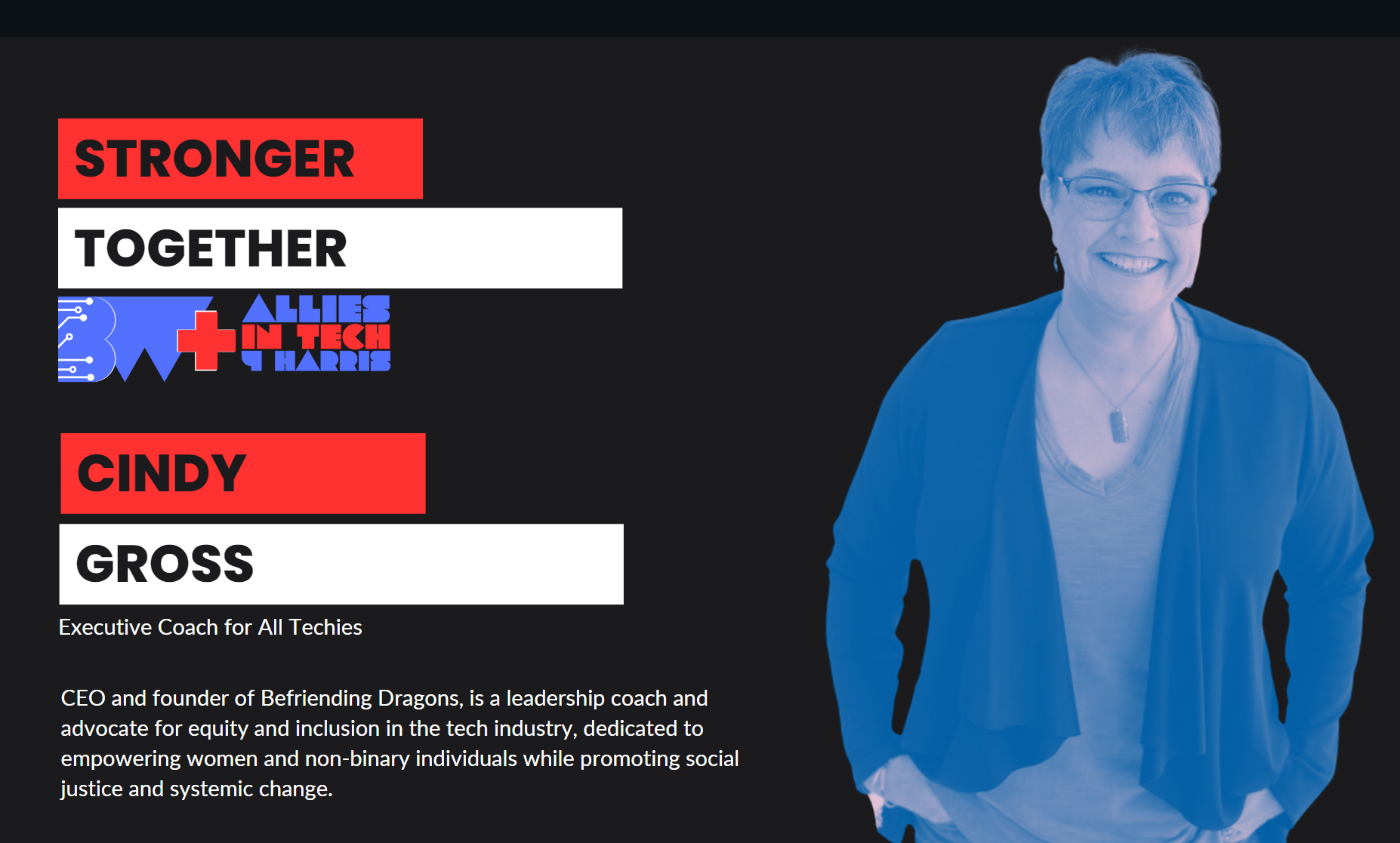
August 2024: I harnessed my inner fire to influence the direction of the tech industry and of our country. I spoke at the Stronger Together: Black Women and Allies in Tech 4 Harris Virtual Summit. Wow – so many powerful folks speaking about our experiences working in tech, how our workplaces and careers are heavily influenced by who is in elected offices, and our dreams for the future! We cannot achieve true equity until we address the systemic barriers that Black women and other women of color face every day – in tech, in our culture generally, and in this presidential race. Why am I talking about politics when this newsletter is about leadership, the tech industry, and careers? Because tech will be more innovative, equitable, and FUN when we elect Kamala Harris. Read more about the impact from this call.
Here’s what I shared at the event (starting at 44:43 in the recording):
It’s an honor to be here today, standing alongside such a powerful community of Black women and allies in tech.
As someone who navigated the tech industry for over 25 years, I’ve seen firsthand the challenges and triumphs that come with being a woman in a male-dominated field. My journey has been shaped by the support and solidarity of communities like this one, and by the belief that together, we can create a more inclusive and equitable tech landscape.
Too many times I was the only woman in the room, and I can’t remember a time when another Native American person was in a work meeting with me. One time, full of excitement, I came to a team meeting and told my boss that I had two women candidates for our open position and his instinctive, immediate response was to tell me “we won’t lower the bar for them.” Picture that — he meant the bar was lowered to let ME in, right? But really nothing was lowered, because the bar is shaped like a white man, with irrelevant gates that exclude so many qualified people, or cut us deeply as we fight our way in. It was a stark reminder of the bias that persists in our industry – and in our elections. It was a turning point for me. I realized that my voice, and the voices of other marginalized individuals, needed to be amplified, we will no longer be silenced.
This experience fueled my passion to advocate for women and non-binary individuals in tech. It deepened my commitment to racial equity, because I understand that the fight for gender equality is intrinsically linked to the fight for racial justice. We cannot achieve true equity until we address the systemic barriers that Black women and other women of color face every day– in tech, in our culture generally, and in this presidential race.
Today, we have an opportunity to make a significant impact. Vice President Kamala Harris has been a steadfast advocate for equity and justice. Her leadership and policies reflect the values we hold dear – values of justice, equity, and belonging, and the belief that everyone deserves a decision-making seat at the table. And to continue this work, HARRIS needs our support.
So many techies have six-figure salaries – I urge each of you to dig deep into your pockets with that in mind and contribute to her campaign. Yes, money is tight for everyone AND often tech rewards us far better than it does people in other industries. Your contributions help ensure that we have leaders who understand the importance of equitable tech policies and who are committed to driving systemic change. Donate, vote, and talk to at least 3people about registering to vote plus a plan on how they will turn in their vote.
Together, we can build a tech industry that not only welcomes but celebrates diversity. WE can create environments where everyone, regardless of their race or gender, can thrive. Let’s stand strong, support Kamala Harris, and continue to push for the inclusive and equitable future we all deserve.
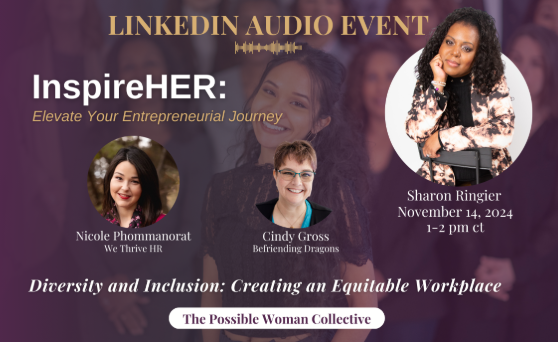
Cindy Gross was a speaker at InspireHER: Elevate Your Entrepreneurial Journey, where she shared insights on inclusive leadership and fostering a workplace culture of belonging and psychological safety. Her approach goes beyond surface-level DEI efforts, helping organizations embed inclusion into their core values. If you’re looking to understand Cindy’s perspective and expertise as a leadership coach, this past event is a great opportunity to listen in and learn more.
It’s becoming common to have “land acknowledgements” at justice focused gatherings. This is a way to recognize and respect Native peoples and their relationship with the land we colonizers stole from them. It also strengthens everyone’s relationship to nature, the lands we occupy, and the communities our dominant cultures often never take the time to see. Sometimes a land acknowledgement is simply asking people to name the traditional territory they reside on as part of their introduction, and sometimes it’s one person bringing a deeper discussion to the gathering. I delivered this land acknowledgement February 12, 2021 to a SheEO gathering. SheEO is a radically generous community supporting women + non-binary people working on the World’s To-Do List. It is an uplifting community for women + non-binary folks starting a social impact business and for anyone who supports social impact businesses through advice, caring, sponsorship, and funding.
Thank you for taking part in today’s land acknowledgement. I encourage those unfamiliar with the practice to learn more about why it is so important and incorporate it into your own communities. I encourage you to use one of the land maps such as https://native-land.ca/ to find what land you occupy, then visit those nations’ sites to get their thoughts on land acknowledgements and how we help each other thrive.
I am Cindy Gross. I reside in Issaquah, WA outside Seattle in the US – the stolen lands of the Duwamish and Coast Salish.
We, I, still benefit from institutions, including governments and schools, built on land stolen from indigenous folk, built with the labor of Black people ripped from their own indigenous homelands.
I am a descendant of both the colonizers and those they tried to destroy – the Lenape, now known as the Delaware, who greeted tired, starving travelers on America’s east coast, and welcomed them to this continent. Our society still suffers from the suppression of the matrilineal cultures of so many indigenous tribes, and we will grow and thrive when we reclaim more of those community focused traits we’ve coded as too feminine and therefore not valuable.
I am descended from the Lenape peoples, and I am a citizen of two Native nations. I know my legally defined blood quantum, but that doesn’t tell me which parts of my DNA are typically found in any specific Native population. DNA does not, cannot, indicate race, cultural connection, or citizenship. My tribal citizenship also doesn’t confer automatic cultural connections – I have few cultural touchstones with own my Native nations. It’s a complex situation – citizenship, DNA, lineage, and cultural connection are all distinct and often inappropriately mixed ways to talk about who is Native. The terms Native, or indigenous, or Indian are also problematic. If you know someone or are talking to or about someone who identifies as Native, use their terminology and where possible their specific Native affiliation.
Remember that native people are still here, still suffering from systemic oppression, and still loving, laughing, and thriving. Choose to honor them, don’t appropriate from them. Live by the idea of “Inspired Natives, not inspired by Natives.” Research when and where it’s appropriate for someone not a citizen of a given Native nation or tribe to use, buy, or wear Native items and imagery. My earrings today for example are made by Lakota artists and sold to support an Indian school. Honor the people behind the items and images you do use. Support Native owned and Native led businesses, community groups, and organizations such as the Navajo Water Project.
Thank you for pausing to SEE and LISTEN TO the Native folks around us.
My land acknowledgement is personal and action oriented. It acknowledges the past, sees Native peoples in the present, and envisions a more equitable future. Native peoples are still here. They are multi-dimensional, complex humans existing in countries that are often openly hostile to their existence as individuals and sovereign nations. This acknowledgement is specific and models good anti-racism practices. Where it was available and clear I used the language preferred by the people I refer to, even where it was inconsistent throughout my story. The bolded line above can be used as part of your introduction to any group – simple and straight-forward. Practice adding land acknowledgements and broaden what you know about Indigenous folks around you.
When should white people quote Martin Luther King, Jr.?
I’ve heard many Black anti-racism advocates say the answer is somewhere between when we deeply understand how to not whitewash his quotes and never, ever, ever. So for any white folks reading this, here’s why we should follow this very reasonable request:
Believe Black people when they tell us we’re harming them.
White people tend to remember, love, and quote the words that let us feel comfortable, safe, and good about ourselves. We can do better and step into discomfort. Stop being performative allies. Move into taking actions that follow the lead of Black people, without forcing them into unwanted or underpaid work, while we white people do the hard work of dismantling the white supremacy we benefit from.
Based on polls at the time, an overwhelming majority of white people absolutely hated MLK – until he was assassinated. Stop taking advantage of our distance from his resistance to whitewash his efforts, to undermine people fighting for justice today. Support Black people however they resist the white supremacy waters we swim in.
There are so, so, so many Black folks out there worth quoting – put some effort into it and learn more about them. We, white people as a whole, are really lazy about learning anything beyond the incredibly whitewashed, male gaze, often totally WRONG history we learned in K-12.
I know, you want to REMEMBER MLK. By not quoting him people will forget about him. Bullshit. We’re not remembering the whole person, the resistance fighter, the dad, the husband in the way we, white people, quote him now. We’re erasing him and his legacy every time we whitewash his words and twist his message. We’re ignoring all the other Black folks who fought alongside him, all the Black folks who chose, who choose, to fight differently. We’re forgetting them and undermining their efforts. We can be better. Do the work. Listen to Black people. Follow their lead without exhausting them or giving them all the risk. Compensate them for the work they do. Yep, it’s hard. That’s what white supremacy does, it creates friction and rough edges and choppy waters. We as white people need to step into those choppy waters and build our anti-racism muscles, take up our share of the burden of changing the course of the white supremacy river.
White people have no excuse for saying “I didn’t know” or “I didn’t realize how bad it is” or “This isn’t The American Way.” We choose not to know. We choose to ignore the Black people who have been telling us they are harmed. It’s on us to listen, to stop making Black people perform their pain for us over and over. Accept that white supremacy pervades EVERYTHING and step up to create change within your scope of control. I guarantee you there are things happening at your neighborhood school, your place of worship, your workplace, and your community or hobby groups that uphold white supremacy. I guarantee you there are things you can do, quietly and with no reward or fanfare, which will chip away at that. White supremacy is EVERYWHERE so take any common practice and ask yourself HOW it upholds white supremacy. Ask that same question to get to deeper levels at least 5 times. Validate with Black people, without asking for their free labor or emotional energy, that what you want to do is useful. There are research papers and books and blog posts and YouTube videos of Black people telling you what they need in whatever scope of control you have. Quite possibly there’s an underfunded group or individual already doing that work – give them your money, your resources, your time, the clout that comes with your white privilege. Listen to them and do something about it.
“…there’s no one way for Black people to combat racism.”
“White people love to pull the same three MLK quotes out of their ass to try to silence Black people when they are feeling uncomfortable and you are whitewashing MLK’s message and taking his quote completely out of f*cking context to try to serve your purpose.”
“He did not like you guys.”
“Martin Luther King is dead. He is not here today because white people did not like him. Because white people use the exact same logic that they use today, on Martin Luther King. Y’all literally assassinated this man.”
“So do not come back today in 2017 and pretend like you were so supportive of Martin Luther King and that all of these ideologies were so great, was so wonderful, and that’s the right way to do things when ‘the right way to do things’ literally got him murdered.”
For them, he is the standard-bearer for resistance while negotiating the minefield of white sensibilities. In the rewriting of history, King has been fashioned into an apologetic freedom fighter who carefully sidestepped white ire while pointing out inequality. They have cunningly backdated their admiration for King and the civil rights movement to prove that they have always stood on the side of justice.
It is bullshit.”
“King explicitly stated: “He who passively accepts evil is as much involved in it as he who helps to perpetrate it. He who accepts evil without protesting against it is really cooperating with it.””
“…because white people are who they are, they’ve decided to create their own version of that legacy. The white people version of MLK is the one we get in our history books and social studies lessons. But now there’s no longer an excuse to pretend to not know what he was truly saying.”
“Systemic racism is as American as apple pie, and Dr. King knew that. He spent much of his time trying to warn Black people on the true nature of not only this country, but the people with power.”
“…they’re so sure they know his beliefs that they’re actually arguing with his children on Twitter. Can you imagine telling someone’s children that they’re wrong about their parents’ beliefs? The caucasity of the internet is wild sometimes, but here we are.”
“White people, until you sit with all of MLK’s words, really sit with them, don’t you dare try and say you know what he meant. Or what actions he would approve (or disapprove) of. He was a man who wanted unity and peace, yes, but he also knew it comes at a cost, and that you’d need to f*ck shit up first to make any progress. If he was still alive, he’d be out there in the streets, marching with us. And don’t you forget it.”
Befriending the dragons lounging on my pile of emails
It’s time for an inbox cleanse. I do this periodically, and it never lasts. I can get close to the coveted “inbox zero” for a few days, and then it creeps back up. I’ve tried tools and techniques and timers and rules…. And still several times this year I’ve had many thousands of emails in my inbox. I can just see my inner dragons settling comfortably on top of the hoard of emails, nestling in and getting comfortable.
Zeke the dragon…. er… orange cat lounging in a box where he doesn’t belong.
So as a generative coach, how do I coach myself to deal with this? I’ll walk you through my internal dialogue and how I got to my current system where as I wrap up this workday I have only 3 emails in my inbox.
How do I feel when I look at my overflowing inbox?
Overwhelmed.
What has worked for me in the past when I feel that way?
Break down the problem into smaller pieces and focus on the impact I want to have. Then I can choose the actions that lead to that impact. For email I’ve already set up a handful of inbox subfolders and rules to direct incoming emails to them and I frequently unsubscribe to newsletters. I overcommit by adding new things to my self-imposed “to do today” list even if I know I can’t get it done that day, and that list is a combo of my inbox, tasks I add to my calendar, and a piece of paper. Basically I’m using my inbox as a set of reminders.
What patterns do I see here?
This is interesting. I often repeat the pattern that discomfort is my comfort zone. I also still get caught in the corporate mindset that I need to have an overfull plate to be taken seriously. Even deeper though, it comes down to a fear of both failure and success. If I focus on the most important things, then my fledgling business is out there in the wild, and I don’t know what will happen. Will people want to work with me? Will I be able to sustain the business both from a personal energy perspective and financially? If it’s successful then…. what? Lots of unknowns that are scary for a whole variety of reasons. Basically having those emails sitting there in my inbox lets me use them as an excuse to avoid dealing with my feelings and to have an excuse for going slow.
What keeps me from taking my next step forward?
As I go through the older emails I am revisiting my past. I’m reminding myself of the missed opportunities, the events I planned to go to and forgot about, the people I didn’t connect with, the idea I did nothing with. The successes were filed away, the failures await me.
And the newsletters, there are so many. This feels like superficial community building, a way to show support, learn from others, and identify potential partners – but it’s not any of those things if I don’t engage beyond subscribing. It scatters my focus and leaves me grasping at shiny objects, just like a dragon adding every bauble in sight to its hoard.
What first step will I take to move forward?
Start with a clean slate. Create a sustainable framework to deal with new calls for my attention, in this case incoming emails.
Will I commit to creating and implementing this framework today? What do I get out of that?
Yes. This will help me stay future-focused and be more intentional in how, how fast, and where to move forward. I’ll focus my internal dragons on my dreams.
My inbox framework
Move all 2000+ inbox emails to a new subfolder under my inbox called __CleanMeUpNow.
I thought it would take me weeks or months to go through the cleanup folder, but in a few hours spread over three days I went from well over 2000 emails to around 150. I sorted by who they were from and deleted many of them in chunks. Many got filed, many more got deleted. I utilized a bunch of “unsubscribe” links.
About a week later I went through every remaining email in the cleanup folder and I’m down to 34. All of them are ideas for creating content like this blog, people I want to connect with, or business building ideas. In other words it’s useful to have that information, and I’ll decide later if there’s another way I want to track those ideas. I don’t have to do it all today.
Deal with new emails a few times throughout the day. Yes, I know some frameworks have other opinions on how often to read new emails. This is what works for me.
Reply or schedule or file.
Ruthlessly unsubscribe. If I find I resist unsubscribing, see how I feel about creating a rule to move it to the “to read” folder that never gets read. Hey, don’t laugh. It works. If I need to ponder more, move it to the cleanup folder. I’m surprised how rarely I need to park emails in the cleanup folder
Post business or partnership ideas to my business notebook in OneNote and file or delete the email.
Give myself 15-30 minutes max at the end of the day to get my inbox to fit on a single screen, about 8-10 emails. I just checked my inbox and realized I had tasks on my calendar to verify two of them are complete by next week (I’m waiting on others) and filed those. That leaves me with one email to address tomorrow!
This is so exciting. I feel lighter and energized! What gets in your way and how will you move forward?
I hope you enjoy this latest Befriending Dragons nugget! Check out my coaching programs and individual sessions. I love to make new connections – please schedule a 15-30 meeting if something I said here resonates with you.